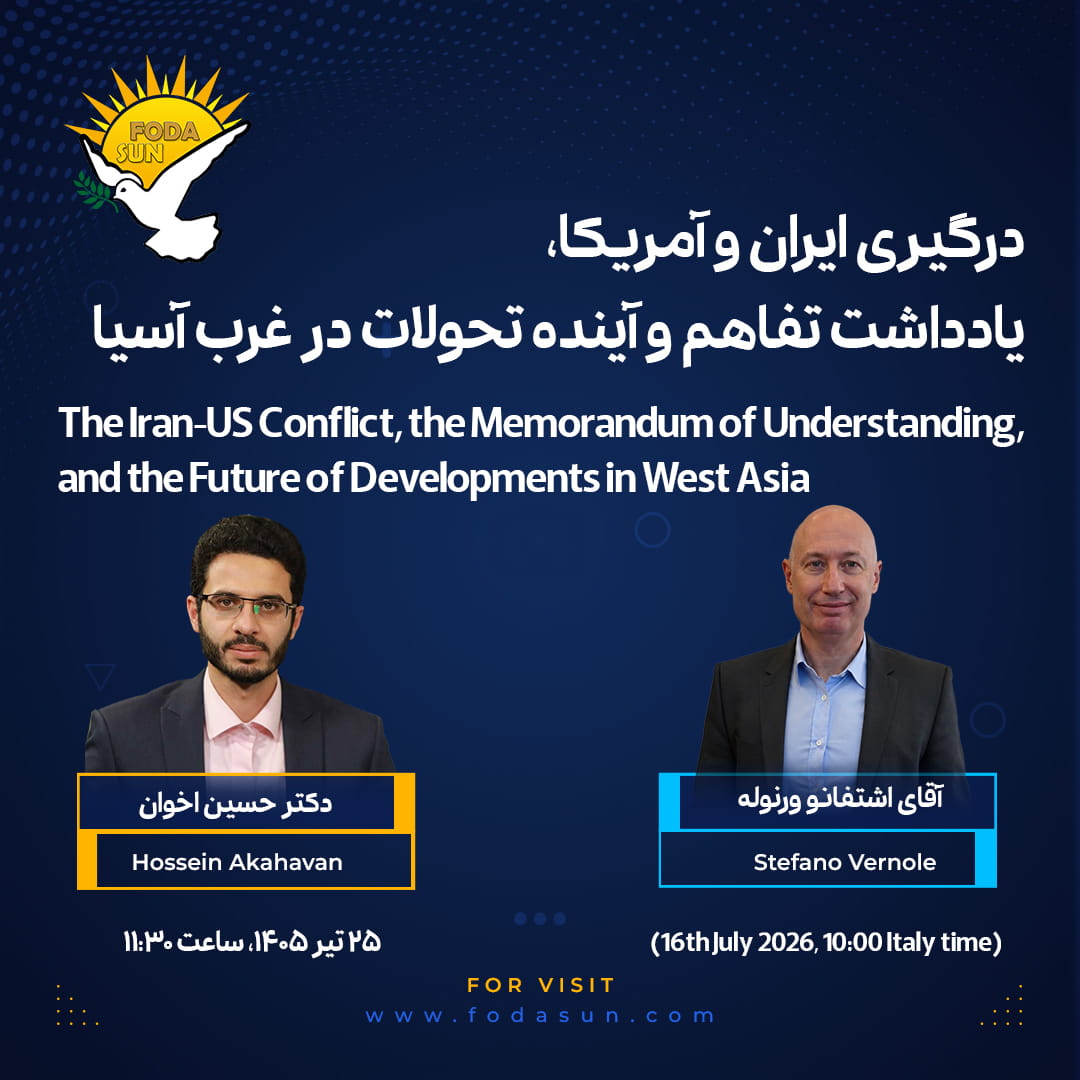
The Foundation of Dialogue and Solidarity of United Nations (FODASAN) held the first meeting of its webinar series, titled ‘The Iran-US Conflict, the Memorandum of Understanding, and the Future of Developments in West Asia’ on July 16, 2026. The event featured Mr. Stefano Vernole, a geopolitical analyst and the Executive Vice President of the Center for Eurasian Mediterranean Studies (CESEM). The full text of FODASAN’s interview with Mr. Vernole is presented below:
In the name of God, good morning everyone.
Good morning, Mr. Vernole.
I hope that you are doing well.
Thank you very much for accepting our invitation.
I hope that we have a productive and insightful discussion and our audience will derive significant value from it.
My name is Hossein Akhavan. And I am an international affairs expert at the foundation of Dialogue and Solidarity of United Nations, or FODASAN. Our NGO is dedicated to creating a platform for dialogue and mutual understanding. We firmly believe that diplomacy and dialogue is the most and the best effective path to achieving sustainable peace.
Today we are honored to be joined by Mr. Stefano Vernole, a distinguished author and geopolitical analyst, who also serves as the Executive Vice President of the Center for Eurasian Mediterranean Studies (CESEM).
Following the outbreak of the war in our country, Iran, over the past months, we have decided to focus our efforts on studying this conflict between Iran and the United States in the region, in the Middle East, With the assistance of prominent political analysts who aim to investigate the various dimensions of this conflict, and ultimately, identify pathways toward ending this conflict or at least the de- escalating tensions.
As you know, the United States and Israel war against Iran on February 28, 2025 marked a turning point in the history of our region, West Asia, or Middle East. Since the outbreak of this conflict, the face of region has been fundamentally changed. Iran has suffered significantly. Some people lost their lives in our country, including martyred supreme leader, Ayatollah Khamenei, and innocent children in, for example, Minab school and other schools or civil places.
Also, countries in the Persian Gulf have faced severe damage, both in terms of their infrastructures and financial stability. Also, the United States failed to achieve its strategic objectives, and expose the limitations of its military effectiveness.
By the signing of the memorandum of understanding between Iran and US, initially raised some hopes for a peace process and a framework for resolving issues through diplomacy. But the complexity of this situation has stopped the process and tensions have raised again, particularly in the Strait of Hormuz.
The current situation is so complex, that the prospects of peace and stability in the Middle East remain in uncertainty. It is indeed difficult to predict the direction of these developments.
For this reason, we have invited Mr. Vernole to share his expertise with us regarding the current state of the Middle East and the future of its developments.
Thank you, Mr. Vernole.
- What is your assessment to this Memorandum of Understanding between Iran and the United States?Do you think this agreement can really reduce tensions in the region?
Thank you for the invitation.
About the first question the Memorandum of Understanding, if implemented would have been a major diplomatic and political success for Iran, which would have obtained significantly better terms than those at the beginning of the conflict.
In particular, the economic clause were extremely favorable the gradual elimination of sanctions will have all over the Iran to finally stabilize the country and exploit it to its vast energy resource.
Furthermore, the memorandum enshrined the full recognition of Iranian sovereignty and would have fostered a significant stabilization of the entire region putting an end to decades of chaos.
Because only with a situation of genuine peace, it is possible to resolve the current tension and foster a Middle Eastern environment open to a foreign investment.
The memorandum could have been the first step in this direction, but unfortunately it was not implemented. Because I think the major problem is the point 5 about the sovereignty of the straight of Hormouz. This is the major problem in this moment.
- What are the main concerns in Europe about this MoU? And What role should the European Union play after this agreement?
In theory, the Memorandum of Understanding would have been advantageous for Europe.as It would have opened up the new geoeconomic opportunities in a region still strategic for the flow of goods and from less privileged positions than the United States would have allowed it to regain access to an important market like Iran for Italian companies.
in particular, my country, have lost billions of euros in the past due to the Western sanctions and the Swift blockade, for financial transactions is impossible for our companies.
From a geopolitical perspective Europe, this is the problem, is not an autonomous entity as long as the remains dependent of NATO, Atlantic Alliance. This is the problem. Without true military sovereignty, the European Union will continue to be the target of Washington strategies which are currently wanting on the front lines against Russia and distant from Middle Eastern diplomacy.
Furthermore, if the conflict in the Middle East continues, Europe will enter in a serious economic recession. And his option will be reduced. This is a great problem for Europe.
- In light of recent statements by Donald Trump claiming that the MoU with Iran is over, how this should be interpreted? Do you view this as a new war or escalation or there is still a window for diplomacy and peace process?
Unfortunately, the Trump administration like any other United States presidency is unreliable. The only language it knows is that of force. And this is the main reason for the renewal conflict with Iran.
But two sides coexist within it; one more pragmatic and less inclined to war for example, today the Vice President Vance admits that Jeffrey Epstein is an agent of Mossad and Chia as a link with Mossad and Chia. This is a signal I think, at the internal administration of Trump. But the other part prevalent now, more near to traditional United States military expansionism.
Above all, this letter side carries a messianic ideological charges, very similar to that of Israel and extremely dangerous and many many many aggressive.
When Trump realize that from the perspective of International and domestic image, that signed memorandum was seen as a defeat for him, He yielded to pressure from the neoconservative whine. This is the problem.
However, United States military power is not infinite; since direct confrontation is difficult, I think reopening a diplomatic corridor after the summer is possible.
Trump needs at least a symbolic success to claim in the media’s eyes. The most dangerous issue concern now the involvement of Arab countries, in aggression against Iran.
This is a strong mistake to normalization, because if they do not want to break away from their deep dependence on Washington, then Iran will have no choice, but to play the regime change card in the Middle East. For example, I think in Bahrain or in other countries. The presence of military bases of the United States in this country is a mortal danger for Iran in its perspective.
- About Arab countries, could you explain more what is the role of these countries, Arab countries in Persian Gulf? Have They a negative position, or a positive?
In this moment, this is a strange situation, because before the Memorandum of Understanding Arab countries aid the United States. After the moral of understanding, I think there is a possibility of an agreement with Iran. This is the position, for example, of China.
China works a lot to sign a piece about Iran and Saudi Arabia, for example.
But I think in the moment after the sign of memorandum of understanding, the neoconservative power in the United States works for destroying this move and works for to recall Arab countries to a significant aid for aggression of the United States against Iran.
For example, Oman can balance the different pressures. But if these Arab countries are instruments of American imperialism, there is not a solution about the war. This is the great problem.
The situation is very difficult to make a prediction. because the crisis of the war, the order that arose from the fall of the Berlin Wall is now irreversible. But it’s the consequence called the very dangerous for the people.
Iran has demonstrated the extreme commitment in resisting the aggression of the Epstein Coalition. And from this point of view, there is not much more to add.
But the future is not certain; because the country has inevitably changed in recent years. And I believe a new form of government is also being considered.
One that preserved institutional form of the Islamic Republic, but with far reaching reforms as a request by segment of population.
For me, it’s essential to overcome the economic crisis caused by Western sanctions for Iran. And Iran will need to increase its ties with all those countries like China and Russia, in particular, that can improve its prosperity. If Iran obtains significant success in reopening diplomacy and the end of economic sanctions, okay, the situation in the Middle East come back to the normality. But if (Iran) persists a situation of war I think the consequence are extreme.
Or United States and Israel obtained an regime change in Iran, or Iran obtained the defeat of the United States and Israel, and the military bases of the United States in the Middle East go to the end. This is the situation now.
I hope there is a new space of diplomacy in maybe August, maybe a month, because the United States have a problem with missiles, with the defense system like Patriots, for example, not have many, many for Missile Tomahawks.
But this is a good perspective for a new space for diplomacy.
But it fails, this space, I think in August or in September, if there is a new total war with a clear winner and clear loser.
- Looking ahead, how do you perceive the future of this conflicts? And what should Iran do for future?
Iran, as demonstrated, is the major regional power. Because the resistance from the attack of the United States and Israel together is very systematic and to demonstrate a great power for this resistance.
But the situation is not optimal for the population, for the people and for the future of the region. And I think you can stranger your partnership, I think with countries like Pakistan, for example. Pakistan is an interesting player in this moment and I think, have interest to have regional stability. And Pakistan is a player to reinforce diplomatic force.
And China too. But the problem is that the imperialistic power in the United States don’t want China diplomacy in the region. This is a big problem.
It’s easier with Pakistan or Qatar, for example, not with China.
- It means that you think that China is a better mediator for solving this problem? China is better than Qatar or Pakistan?
Yeah, in theory, yes. But the problem is the opposition of Occidental forces to have China as a Mediator. because if mediation have a good success, the prestige of China arose and this is a problem for image of the United States in the world.
And now the tactic is better to have Pakistan and Qatar, But China remains as a great partner for economy, for intelligence information, technological aid. for this, China is the best partner in this moment and Russia too.
- And finally, from a geopolitical view, because I know that you are a geopolitical analyst, can you give us a big picture, landscape of this conflict from geopolitical view. For specifically in the multipolar world, for example. Because we are turning, we are toward a multipolar system in the world. Can you tell us what is the role of Iran in this region and regarding to it, these conflicts is for what? Why these conflicts are very tough in our region?
The role of Iran is very important, because with Iran if you are a Eastern power, you have two choice.
you have a conflict with Iran, like in this moment, this is the situation. But if you have good relations with Iran, you can have a good diplomatic relation with Iran. Iran is very important for stabilize entire the Middle East and Eastern Asia because the influence, cultural influence of Iran is very large.
It’s not only Iran. It’s in Iraq, Syria, Lebanon, Yemen, Afghanistan, Pakistan too. It is the traditional influence of Persian Empire in the past, but Islamic Shiites in the region now.
Iran has a heritage of a great culture, traditional culture, and have demonstrated a good capacity to obtain results. If you want to speak with Iran. but it’s important to understand that Iran is not simple, because in the West there is a strange image of not only about Iran, but in general of Islamic world.
And there is an image that, for example, Islamic world is the Arab world or the most important Islamic State are for example Saudi Arabia or United Arab Emirates or Qatar.
But this is the major in Western councils. But in reality, for example, the most important Islamic states are Indonesia, Pakistan really not Arab states or for example. in Western opinion, they don’t know that in Iran, the majority is not Arab people.
- Okay, if you have a final speech, we can hear.
Thank you for invitation.
And I think it’s possible to have a new situation in the Middle East for peace and stability. because the potential stabilization in the world, for economy, for behavior I mean the best behavior of people is possible. but it’s necessary to have a new perspective.
The dialogue of civilization against the war of civilization. This is for me the world order that must prevail now.
- Thanks very much, sir. Thank you. And I hope that we can have another conversation in future.
- Thank you. Bye bye.