Preamble
According to the United Nations Development Programme (UNDP), human development involves enhancing people’s capabilities, expanding their choices, extending their freedoms, and promoting human rights for all citizens. This conception of development transcends mere economic growth, centering instead on people’s lives (1). On this basis, economic security, access to employment opportunities, the ability to meet basic needs, the continuity of public services, and the enjoyment of educational and health opportunities are among the factors that make the realization of human development possible. Regarding the 2026 war against Iran, examining its economic consequences for human development requires more than calculating direct damages. It also necessitates understanding the war’s effects on daily life, household livelihoods, employment, food security, and access to basic services.
During Donald Trump’s presidency, intensified United States sanctions against Iran, the Twelve-Day War, and the activation of the snapback mechanism created a pervasive atmosphere of threat and uncertainty throughout the country. The continuation of sanctions policies and the persistence of a “no war, no peace” situation aggravated economic difficulties, affecting the prospects for productive and commercial activity and the country’s developmental trajectory. The war waged by the United States and Israel in 2026, the comprehensive expansion of unilateral U.S. sanctions, and the naval blockade in recent months rendered the situation even more intractable. According to the President of Iran, these pressures have led to a 35 percent decline in Iran’s exports and imports (2).
A Review of the 2026 United Nations Development Programme Report
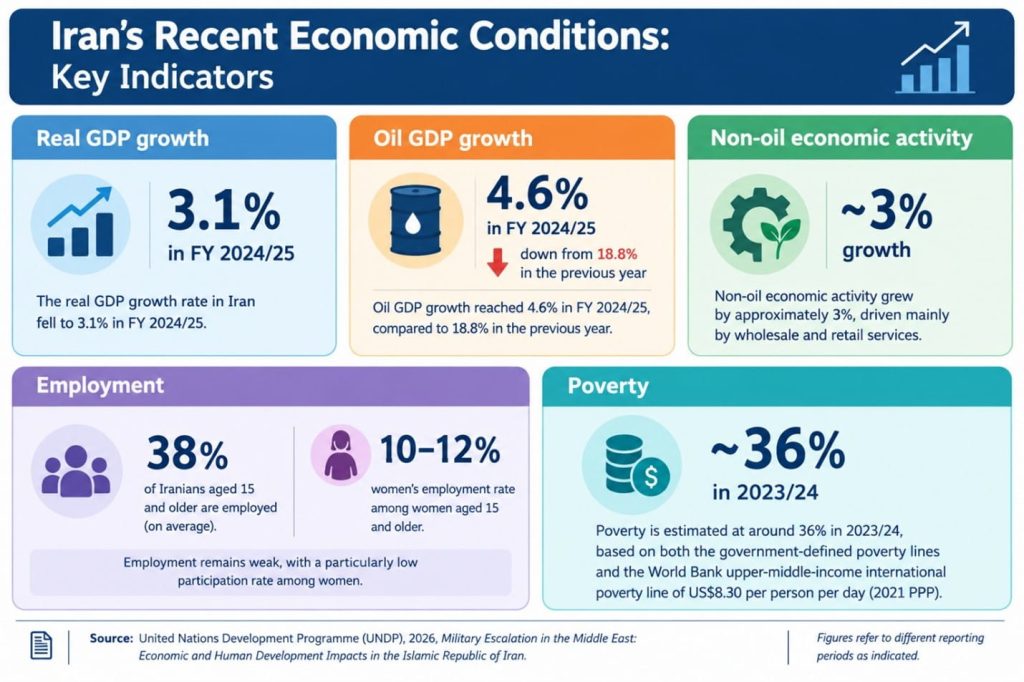
On 31 March 2026, the United Nations Development Programme published a report assessing the state of Iran’s economic and human development. It examined the period before and after the Twelve-Day War, during the 2026 war, and offered an outlook for the future (3). According to the report, the escalation of military tensions in the Middle East placed Iran’s economy and its human development trajectory at risk. Energy infrastructure and maritime trade routes (including passage through the Strait of Hormuz) were disrupted. In the initial phase of this escalation, global oil prices surged by over 30 percent, intensifying inflationary pressures and increasing import costs. Significantly, these shocks are impacting an economy already grappling with macroeconomic volatility, diminished purchasing power, and the repercussions of sanctions. Iran’s per capita gross domestic product has declined from more than US$8,000 in 2012 to approximately US$5,000 in 2024, indicating a gradual, long-term erosion of living standards (page 3 of the report). As a result of this situation, macroeconomic pressures have intensified in recent years. Inflation has remained persistently high, averaging above 40 percent over the past several years, and is projected to reach 55 percent in 2026 before declining to approximately 50 percent in 2027. Iran’s national currency has likewise experienced dramatic depreciation, reaching approximately 1.45 million rials per US dollar by late 2025, which further increases the domestic cost of imports and basic goods (page 4 of the report). According to the United Nations Development Programme report, the following statistics are noteworthy. Some figures pertain to the period before the Twelve-Day War and the 2026 war. These data are important because they offer a picture of Iran’s economic realities prior to the escalation of hostilities and the crisis. They also provide a basis for better understanding the cumulative effects of the war on macroeconomic indicators, household livelihoods, and the country’s developmental capacities.
- Real GDP growth: 3.1 percent in fiscal year 2024/2025.
- Oil-sector GDP growth: 4.6 percent in fiscal year 2024/2025, compared with 18.8 percent in the previous year.
- Non-oil economic activity growth: approximately 3 percent.
- Employment-to-population ratio: 38 percent of Iran’s population aged 15 and above.
- Female employment rate: approximately 10 to 12 percent of women aged 15 and above.
- Poverty rate: approximately 36 percent in 2023/2024, based on Iran’s national poverty lines.
Estimates from the United Nations Development Programme in March 2026 indicate that the economic effects of the war may extend far beyond direct damage to infrastructure. According to the UNDP’s simulations, assuming a 28-day disruption to trade, a decline in productivity, and the destruction of physical capital, Iran’s real GDP growth in 2026 could be reduced by 8.8 to 10.4 percentage points compared with a hypothetical no-war scenario.
Prior to the conflict, Iran’s Human Development Index had improved steadily despite sanctions and placed the country in the “high human development” category. However, UNDP simulations indicate that Iran’s HDI could decline by 0.47–0.56 percentage points, resulting in the equivalent of a year to a year and a half loss of human development progress. In addition, the conflict has the potential to have longer-term implications for health through indirect damage to health systems and population well-being (page 6 of the report).
Assessment of the Current Situation
The outlook presented in the United Nations Development Programme’s March report must now be examined in light of current circumstances. According to the newspaper Donya-e-Eqtesad, the economic effects of the war are evident in both foreign trade and household livelihoods. Iran’s non-oil exports fell by nearly 28 percent in the first five months of the Iranian year 1405 (March–August 2026). This trend, coupled with rising transportation and insurance costs and uncertainty over foreign-exchange obligations, has placed added pressure on exporters. At the same time, private final consumption in spring 1405 (2026) declined by 4 percent compared with the same period of the previous year, indicating declining household welfare and weakened domestic demand. This may also stem from an assumption that the current crisis is permanent (4). According to the same source, the sharp rise in food prices in the wake of the 40-day war, the surge in the exchange rate, and disruptions to international trade have diminished the effectiveness of support policies. Based on data from the Statistical Centre of Iran, point-to-point food inflation reached 121.1 percent in Shahrivar 1405 [August–September 2026], such that approximately 78 percent of the minimum wage of a four-person household is spent on securing food. By contrast, a one-million-toman food coupon covers only 17 percent, and a 1.5-million-toman coupon approximately 26 percent, of this household’s food expenditure (5). According to one economist, it would take approximately five years for the country to return to the economic level of Farvardin or Ordibehesht 1404 [April–May 2025], even if sanctions were lifted (6).
Differing figures have been cited regarding the damages of the war. Some speak of a figure of 28 billion dollars; moreover, Iran’s Minister of Economy has announced that insurance companies alone have paid approximately 50,000 billion tomans to compensate for damage to automobiles and residential homes, and 80 million dollars to compensate for damage sustained by ships and aircraft during the war (7).
Overall, the narrative presented by Iran’s domestic newspapers regarding the post-war situation is as follows: high inflation and the depreciation of the currency have sharply eroded people’s purchasing power; industrial and export supply chains have been damaged; and gains in human development are being reversed. As to the pace and effectiveness of reconstruction, there are debates and differences of opinion within Iran.
In such a situation, an imbalance arises between public needs and available resources. On the one hand, reconstructing damaged infrastructure, supporting low-income households, compensating firms for their losses, and sustaining the delivery of public services require greater financial resources. On the other hand, the contraction of economic activity, disruption to oil exports and trade, and rising import costs may place added pressure on public revenues and expenditures. This situation may give rise to a conflict between funding the necessary costs of reconstruction and securing long-term financing for education, health, housing, and other public services. If public resources prove insufficient to compensate for damages and provide social protection, households will be compelled to allocate a larger share of their income to healthcare, education, and the provision of basic needs—a development that carries serious consequences, particularly for low-income groups, and may restrict their access to these services.
Returning to the Framework of the Right to Development
From the perspective of the right to development, the central question is how war restricts individuals’ capacity to enjoy a decent life, to access economic opportunities, to participate in social activities, and to benefit from basic services. Within this framework, rising poverty is not merely a loss of income; disruption to education is not merely the closure of schools; and the destruction of medical centers is not merely a loss of buildings and equipment. Each of these consequences can narrow the range of people’s real choices and diminish their ability to enjoy the full range of economic, social, and cultural rights.
References
- https://www.undp.org/sites/g/files/zskgke326/files/2023-02/CK_Slides_FINAL_ENG.pdf. Accessed 21 October 2026.
- (29 August 2026). War weighs on Iran’s economy as US intensifies sanctions. https://www.reuters.com/world/asia-pacific/war-weighs-irans-economy-us-intensifies-sanctions-2026-08-29/. Accessed 21 October 2026.
- (31 March 2026). Military Escalation in the Middle East: Economic and Human Development Impacts in the Islamic Republic of Iran. https://www.undp.org/asia-pacific/publications/military-escalation-middle-east-economic-and-human-development-impacts-islamic-republic-iran. Accessed 21 October 2026.
- Donya-e-Eqtesad. (15 October 2026). Two Economic Snapshots of the War. https://donya-e-eqtesad.com/fa/tiny/news-4301932. Accessed 22 October 2026. (In Persian)
- Donya-e-Eqtesad. (20 October 2026). The Vicious Cycle of Inflation and Recession. https://donya-e-eqtesad.com/fa/tiny/news-4302954. Accessed 22 October 2026. (In Persian)
- (28 June 2026). Interview with Hojjat Mirzaei. https://www.entekhab.ir/003tOn. Accessed 22 October 2026. (In Persian)
- (7 October 2026). Payment of 50 trillion tomans in war damages in the housing and automobile sectors. https://www.ilna.ir/fa/tiny/news-1849452. Accessed 22 October 2026. (In Persian)