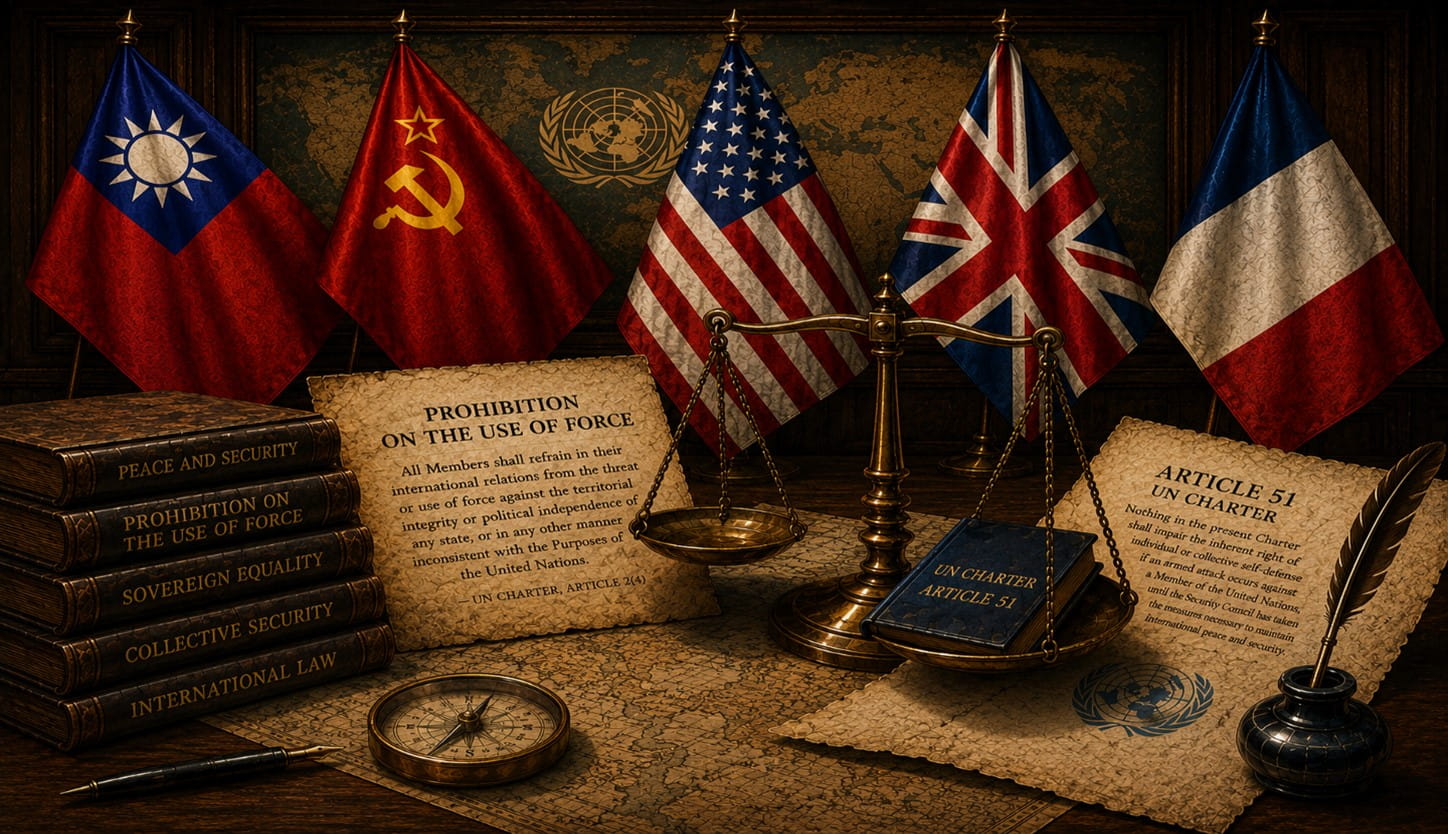
During the third informal consultative meeting of the five major Powers—the United States, the United Kingdom, France, the Soviet Union, and China—held on May 12, 1945, on the margins of the San Francisco Conference, France submitted a proposal regarding exceptions to the prohibition on the use of force. The British delegation supported this proposal. Their view was that if the Security Council failed to act against a breach of the peace, Member States should retain the right to take necessary measures to preserve peace, justice, and the rule of law.
In its subsequent negotiations, the United Kingdom proposed a more qualified approach, suggesting that unilateral military action should be permissible under Article 51 of the UN Charter, specifically within the framework of self-defense. In contrast, the American delegation advocated a restrictive interpretation of self-defense. Harold Stassen and John Foster Dulles, senior United States negotiators, stated in a joint meeting with the British delegation that the proposals under consideration would unduly expand the scope of self-defense, thereby jeopardizing the very existence of the Organization. Ultimately, the text adopted in Article 51 of the Charter reflected the United States’ position. Stassen and Dulles thus became the American architects of the right of self-defense as limited by the UN Charter (1). A re-examination of this narrative, as recorded in the diplomatic records of the “Foreign Relations of the United States for 1945” concerning the United Nations, reveals a manifest contradiction when compared with United States policies and military actions over the past several decades.
The formation of the prohibition on the use of force in international law has traced a path marked by twists and turns, replete with historical complexities. The history of states during the era of monarchical rule was more a chronicle of wars and bloodshed. In past eras, war was the foundation of international relations and occupied an exceptionally superior position among methods of settling disputes. In contrast, scholars endeavored to halt this trend through the articulation of theories of just war. From ancient times to the Renaissance, figures such as Confucius, Lao Tzu (Tao), Cicero, Saint Augustine, Vitoria, and Suárez advanced theories asserting that war is permissible only when justified by legitimate causes, including the protection of the oppressed against oppressors (2). Hugo Grotius, the father of international law, also viewed war as just solely for the purpose of punishing evildoers and oppressors (3). However, the great powers of the world had no desire to abandon the instrument of war, and ideas that sought to restrict the use of force failed to gain any foothold or attention.
The Kellogg-Briand Pact, signed in 1928 by France and the United States, was the first treaty to prohibit the use of force and aggressive war, and to mandate the use of peaceful means for dispute resolution. The pact later became multilateral. In response to the atrocities committed by the Axis states during the Second World War, the London Agreement of 1945 (commonly known as the Nuremberg Charter) criminalized aggressive war as a crime against peace. Ultimately, Article 2, paragraph 4 of the United Nations Charter recognizes the prohibition on the use of force as one of its core principles. The organization in Chapter VII then outlines two exceptions: first, military action to maintain international peace and security, authorized by the Security Council pursuant to Article 42; and second, self-defence under Article 51. By limiting exceptions to the use of force to these two cases, the UN Charter effectively ends the legitimacy of unilateral military action.
Self-defence in international law means that whenever a State is subjected to an armed attack by another State, it is permitted, under the rules of international law, to defend itself. Pursuant to Article 51 of the Charter, if an armed attack occurs against a Member of the United Nations, nothing in the Charter shall impair the inherent right of individual or collective self-defence until the Security Council has taken the measures necessary to maintain international peace and security. Accordingly, the Charter recognizes self-defence as lawful in the event that an armed attack occurs against a Member State. In its Judgment in the case concerning Military and Paramilitary Activities in and against Nicaragua, the International Court of Justice affirmed that the exercise of the right of self-defence is subject to the conditions of necessity and proportionality, and held that this requirement forms part of customary international law (4). In response to these limitations, certain States and scholars, invoking imminent threats and dangers, have proposed new approaches that do not condition military action taken for the purposes of self-defence upon the occurrence of an armed attack by the opposing party. From this approach emerged the doctrines of preemptive and preventive self-defence, which have been invoked to justify numerous wars. Notwithstanding the Charter’s explicit prohibition on the use of force, some, under the pretext of protecting human rights, invoked the doctrine of humanitarian intervention, and this doctrine rapidly became, in their view, a political and legal pretext.
All of these new approaches have been advanced notwithstanding the fact that the explicit language of the Nations Charter leaves no room for ambiguity; moreover, pursuant to the United Nations General Assembly Resolution on the Definition of Aggression, the use of armed force by a state against the sovereignty, territorial integrity, or political independence of another state, or in any other manner inconsistent with the Charter of the United Nations, constitutes aggression (5). Accordingly, such acts must be regarded as violations of international law.
If states, through unilateral interpretation, expand concepts such as armed attack, necessity, proportionality, imminent threat, and the fight against terrorism to such an extent that virtually any military action may be characterized as self-defence, the boundary between the rule and the exception will, in practice, be effaced. If self-defence is treated as a general license to resort to force, this will lead to the gradual erosion of the rule prohibiting the use of force. Self-defence is a limited exception to a foundational rule and must be interpreted in light of the object and purpose of the Charter.
States such as the United States and the Israeli regime, by advancing expansive interpretations of the concept of self-defence and invoking various doctrines — such as anticipatory and preventive self-defence, humanitarian intervention, the responsibility to protect (R2P), and the fight against terrorism — have sought to portray their policies as consistent with international law. This has led some to conclude that, through a structural pattern, aggressive and hegemonic acts are being redefined within legal discourse—a pattern that, for instance, characterizes resistance movements as a terrorist threat against which self-defence is purportedly being exercised (6).
The doctrine of preemptive self-defence, if accepted, pertains to a situation in which an armed attack is considered imminent, whereas the doctrine of preventive self-defence pertains to countering a future threat, absent a comparable degree of necessity and urgency. The Israeli regime, in its letter to the Security Council justifying Operation Rising Lion, claims that it has, for decades, been subjected to attacks by Iran through proxy groups and repeatedly refers to future threats—including the development of nuclear weapons—the timing of which remains uncertain (7). Such an attack constitutes an instance of ostensibly preventive action that cannot be reconciled with the foundational principles of the United Nations Charter; it recasts self-defence in accordance with any interpretation a State subjectively chooses to adopt, thereby placing every State in the position of sole arbiter within the international system. The point is that Israel has, for several decades, asserted in various political and media circles that Iran is on the verge of developing nuclear weapons—this notwithstanding the fact that Iran, by undertaking unprecedented commitments, has accepted extensive monitoring of its nuclear program.
By contrast, Israel is not a party to the Treaty on the Non-Proliferation of Nuclear Weapons. Over the past decades, it has been repeatedly condemned or censured in Security Council resolutions—such as Resolutions 171, 228, 236, 465, 487, and 518—for unlawful military actions, ceasefire violations, attacks on civilians, and acts of aggression against various States (Lebanon, Egypt, Jordan, Syria, and Iraq). Similarly, in the Advisory Opinions of the International Court of Justice concerning the Wall (2004), the Legal Consequences of Israel’s Policies and Practices in the Occupied Palestinian Territory, including East Jerusalem (2024), and Israel’s Obligations in relation to the Presence and Activities of the United Nations, Other International Organizations and Third States in and in relation to the Occupied Palestinian Territory (2025), it has been found in violation of international law. Moreover, officials of this regime are subject to prosecution before the International Criminal Court. Taken together, these facts suggest less the victimhood of a State than an inversion of right and wrong; it is as though the regime seeks, by manipulating the rules governing the use of force, to transform itself from the accused into the self-appointed embodiment of righteousness.
Interventions by the United States in various countries have repeatedly been justified under the guise of self-defence, humanitarian intervention, or the responsibility to protect. Humanitarian intervention, being a unilateral measure undertaken on the asserted basis of protecting human rights, constitutes a violation of the rule prohibiting the use of force, owing to its lack of any explicit basis in the Charter. The doctrine of the responsibility to protect, which was advanced as a development of humanitarian intervention and as a means of striking a balance between respect for fundamental human rights and state sovereignty, likewise accords priority to preventive and non-military measures; and, pursuant to the most recent practice agreed upon by states, any resort to force must be undertaken within the framework of Chapter VII of the Charter and with the authorization of the Security Council (8). Moreover, the boundary between the protection of human rights and geopolitical interests is so deeply intertwined that the implementation of doctrines of this kind is inherently attended by controversy. For instance, although the military intervention in Libya was authorized by the Security Council, the failure to observe the principle of post-intervention societal reconstruction and to ensure compliance with international humanitarian law throughout the conflict rendered the intervention the subject of criticism by a large number of States.
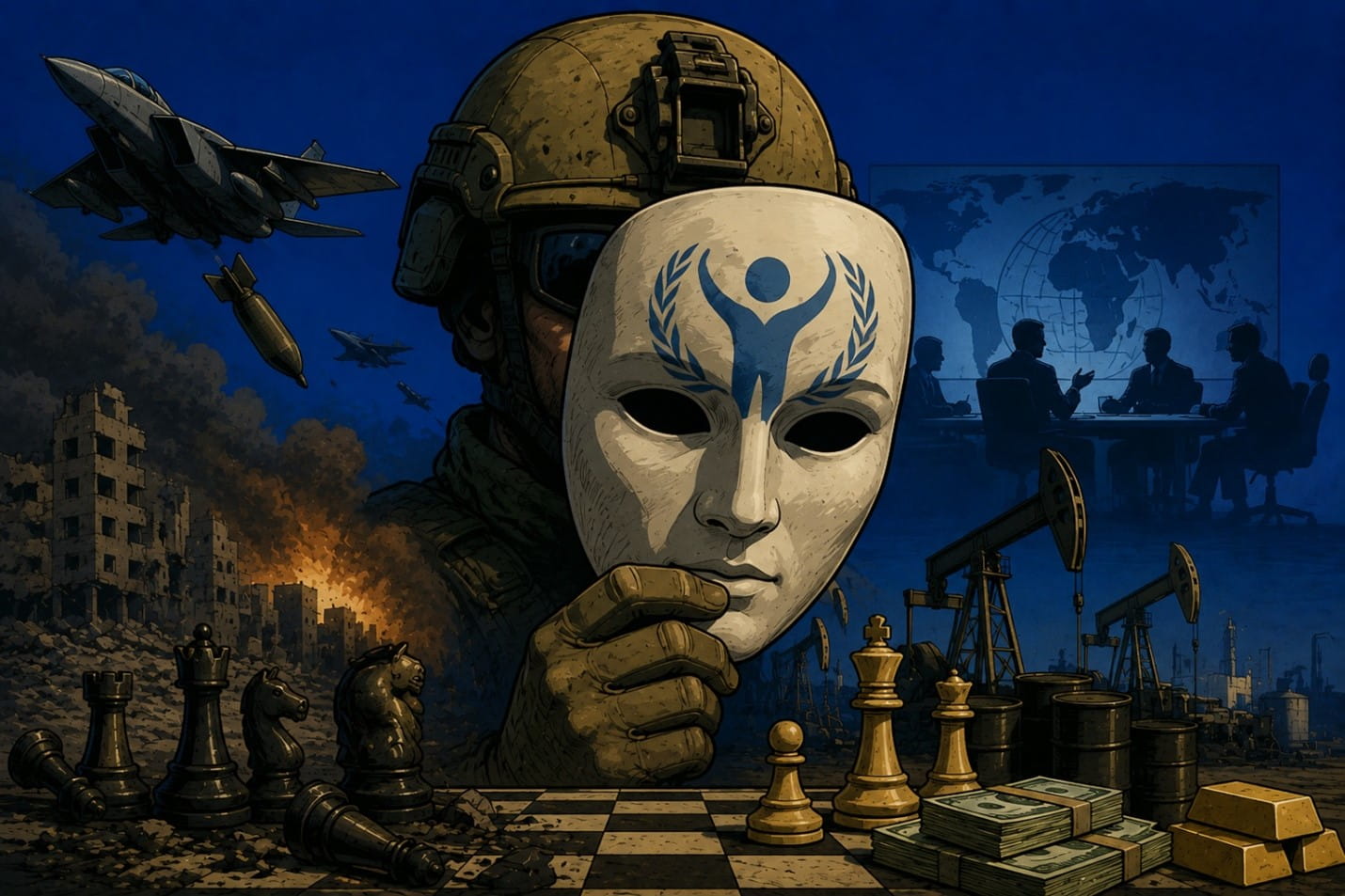
Following the terrorist attacks of September 11, 2001, a turning point emerged in the realm of United States military interventions. With the raising of the question whether an attack by a non-State actor could be characterized as an armed attack within the meaning of Article 51, and whether force could accordingly be used against the State on whose territory that group operated, the issue of the lawfulness of the use of force confronted a new challenge. However, the discussion extends beyond the mere recognition or non-recognition of such a possibility; even if such a resort to force were to be accepted, this could not be construed as conferring unlimited authority upon the State that has been the target of an attack by a terrorist or non-State group. The relationship between the attack and the response, the necessity of the action, its proportionality, the temporal and territorial scope of the operation, and its connection to the responsibility of the State on whose territory the group is based must still be carefully assessed within the framework of the “effective control” and “due diligence” standards. Disregard of these considerations transforms the fight against terrorism into yet another pattern for justifying wars of broad scope.
As has been observed, the United States and the Israeli regime have, over recent decades, repeatedly exceeded the bounds of positive international law and undertaken unilateral military actions against various States. Iran has now been the target of aggression by these two actors. Yet the continued overshadowing of positive law by politics will not render Iran the last victim State — just as Palestine, Vietnam, Lebanon, Iraq, Syria, Afghanistan, Libya, Venezuela, and several other countries were not the last instances either.
The aggression by the United States and Israel against Iran was carried out without the authorization of the Security Council; moreover, no armed attack on the part of Iran preceded their military action such as would entitle them to claim self-defence. Allegations concerning Iran’s proximity to acquiring nuclear weapons have been advanced by these aggressor States for more than several decades, notwithstanding that Iran has repeatedly demonstrated flexibility with respect to its nuclear program and, over the past two decades, has never abandoned negotiations on this matter. Under the Joint Comprehensive Plan of Action (JCPOA), Iran accepted extensive restrictions on its nuclear program and agreed to submit to rigorous monitoring of its nuclear facilities. Within the past year and a half, Iran sat at the negotiating table with the United States on two occasions with a view to resolving tensions through peaceful means, yet on both occasions it was subjected to attack by the United States and Israel. Following the Islamabad Memorandum of Understanding as well, the United States, alleging a violation of the ceasefire by Iran, once again carried out targeted strikes against that country’s infrastructure. Beyond the unlawfulness of these attacks, it must also be noted that the construction of a nuclear bomb requires the attainment of an advanced level of nuclear technology and access to specialized facilities and materials, and whether Iran possessed such capabilities is a matter requiring careful assessment.
It must also be noted that, in any war (whether lawful or unlawful), compliance with international humanitarian law is mandatory; nevertheless, in the majority of aggressive wars that are justified through narrative construction and expansive interpretations, violations of these rules are conspicuously evident. In the war against Iran, attacks on infrastructure containing hazardous materials (nuclear facilities), energy infrastructure, schools, hospitals, residential areas, scientific centers, and vital lines of communication constituted instances of such violations. On the whole, it must be concluded that the party possessing the right of self-defence is Iran, and not the parties that wage war on the basis of sweeping allegations devoid of any reasonable foundation.
A final point is that the present situation does not signify disregard by States for international law; rather, it demonstrates that States, in resorting to force, seek to justify their actions within the framework of one or another existing legal rule — a fact that itself attests to the significance of this legal order. What is noteworthy may instead be characterized as a struggle over the interpretation of international law. Great Powers, in many instances, seek to expand the scope of their authority by redefining legal concepts; conversely, other States, together with judicial and international institutions, endeavor to keep the boundaries of such authority confined. The contest, therefore, is not confined solely to battlefronts and the skies of States, but continues unabated as a domain of legal and diplomatic contestation among States before international courts and organizations.
Alireza Rezakhani; LL.M of International Law, University of Tehran
References
- Foreign Relations of the United States, Diplomatic Papers, 1945, General: The United Nations, Volume I, https://history.state.gov/historicaldocuments/frus1945v01/d224.
- S. Mani, “Humanitarian International Today”, 2005, Collected Courses of the Hague Academy of International Law, Vol.313, https://referenceworks.brill.com/display/entries/HACO/A9789004145559-01.xml?language=en.
- Vaughan Lowe and Antonios Tzanakopoulos, “Humanitarian Intervention”, 2011, in Max Planck Encyclopedia of Public International Law, eds. Anne Peters and Rüdiger Wolfrum, (Oxford, University of Oxford), https://opil.ouplaw.com/display/10.1093/law:epil/9780199231690/law-9780199231690-e306.
- Military and Paramilitary Activities in and against Nicaragua (Nicaragua v. United States of America), Merits, Judgment, I.C.J Reports 1986, https://www.icj-cij.org/case/70.
- UNGA Resolution 3314, https://documents.un.org/doc/resolution/gen/nr0/739/16/img/nr073916.pdf?OpenElement.
- https://bigdeliacademy.com/1405/05/17/pouya-brelian/ (In Persian)
- S/2025/390, https://documents.un.org/doc/undoc/gen/n25/162/48/pdf/n2516248.pdf
- World Summit, 14-16 September 2005, https://www.un.org/en/conferences/environment/newyork2005.