
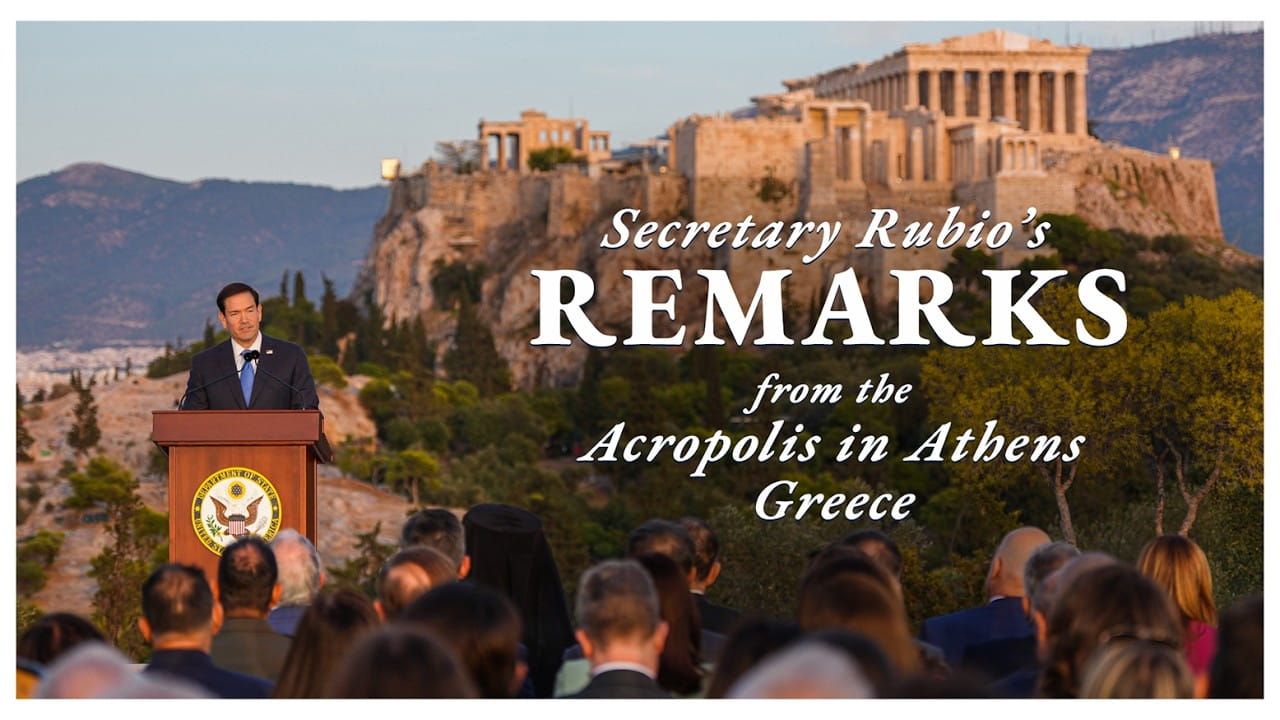
Secretary of State Marco Rubio’s October 7, 2026, speech on Pnyx Hill in Athens, facing the ruins of the Acropolis, was a blatant attempt to revive ancient civilizational binaries and exploit them to justify US expansionism toward the East, and specifically to provide a pretext for attacking Iran.
Rubio seeks to forge an acute rift between the West and the East—particularly Iran—by creating dichotomies such as “Iranian aggression” versus “Greek valor,” and “life-affirming Western heroism” versus the “cult of death” in Iranian thought, contrasting Western expansionism and audacity (Thumos) with Eastern stagnation and survivalism.
Rubio anchors his speech in a specific historical turning point: Xerxes’ 480 BCE invasion of Athens. He introduces Achaemenid Iran as the “greatest empire of that era,” but not as a sophisticated political or civilizational order; rather, he portrays it as a destructive force (“Persian invaders”) that burned temples, razed the Acropolis, and symbolized aggression, corruption, and blind fury. Conversely, he paints the Greek defenders of the Acropolis and the 300 Spartans facing the massive Persian army as eternal symbols of liberty, resistance against Eastern imperial dominance, and honorable sacrifice for the homeland.
Another instance of this artificial dichotomy concerns his critique of the concept of martyrdom in the Islamic Republic’s ideology. Here, he draws a sharp moral line between the two civilizations. In his view, Western myths—Socrates, the Spartans, Achilles, Christian martyrs, the American patriot—are willing to sacrifice their lives for duty, honor, and truth, yet they are not “in love with death”; they understand the value of life, which is precisely why their sacrifice is honorable. In contrast, he launches a direct attack on the “radical mullahs of Iran,” framing their ideology as a “cult of death” that views martyrdom not as an honorable means to preserve principles, but as a pathological value resulting in “suicide children”—a patently false and prejudiced claim. Consequently, he argues that concepts like “honor,” “duty,” and “heroism” are not universal, but rather products of a specific Greek/Western bio-ethics, thereby portraying Iran’s value system as inherently alien and antithetical to human and Western moral values.
Furthermore, by proposing the false dichotomy of the Greek “outward-looking” perspective versus the “inward-looking” nature of others, he claims that in many other civilizations throughout history, the highest goal of life has merely been “stability, comfort, and subsistence.” In contrast, he describes the Western spirit—derived from Greece—as filled with Thumos (ambitious courage), an “outward-looking” disposition, the conquest of the unknown, and a constant striving for excellence, competition, and discovery; a spirit that stretches from the Macedonia of Alexander and the Rome of Caesar to the caravans of Christopher Columbus and Apollo 11.
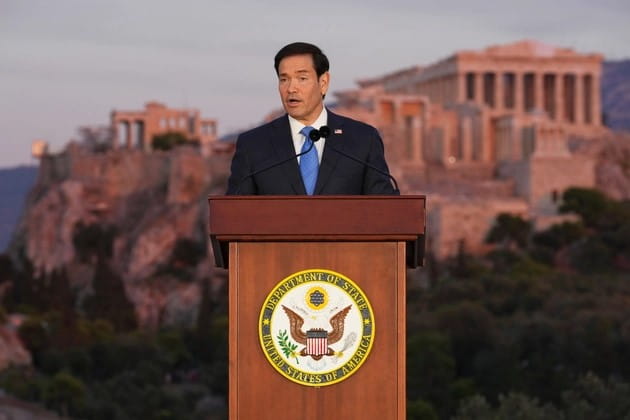
The reality is that none of Rubio’s alleged dichotomies are rooted in fact. Regarding the historical debate over Xerxes’ invasion of Athens, contrary to Rubio’s reductionist narrative that depicts the burning of the Acropolis as a groundless, barbaric raid, historical documents—especially the reports of Herodotus—show that Xerxes’ 480 BCE action was a retaliatory response to the burning of the city of “Sardis” (the capital of the Persian satrapy in Lydia) and the destruction of the sacred temple of “Cybele” by Athenian forces during the Ionian Revolt in 498 BCE. This event had incited the wrath of Darius the Great, and Xerxes’ campaign was fundamentally launched with the official declaration of legal and religious punishment for Athens in response to that prior profanation. Therefore, omitting the background of the Athenian burning of Sardis in Rubio’s speech is a blatant distortion designed to invert reality, cultivate a narrative of civilizational victimhood, and conceal Athens’ role as the initiator who sparked the cycle of violence.
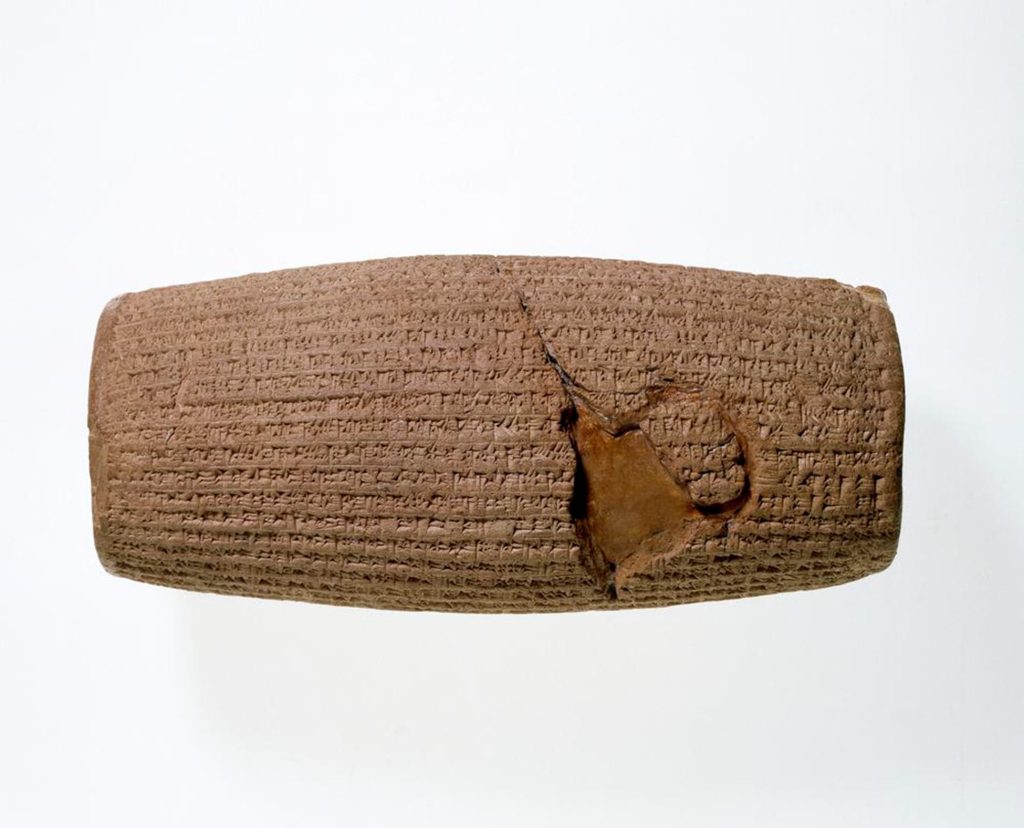
A look at Iranian history reveals that Iranians have always been a benevolent and free-thinking people. For instance, Achaemenid governance was based on principles of coexistence, respect for cultural diversity, and freedom of religious observance for various nations; a truth whose complete manifestation and brilliant document is crystallized in the “Cyrus Cylinder.” After conquering Babylon, unlike the standard practice of ancient conquerors to destroy and enslave societies, Cyrus the Great established a progressive model of “governance based on tolerance, respect for human rights, and the freedom of will of nations”—a monumental model demonstrating that Iran’s historical statecraft, since antiquity, has respected human dignity and freedom, not merely in propaganda slogans, but within the political and moral structure of governing its empire.
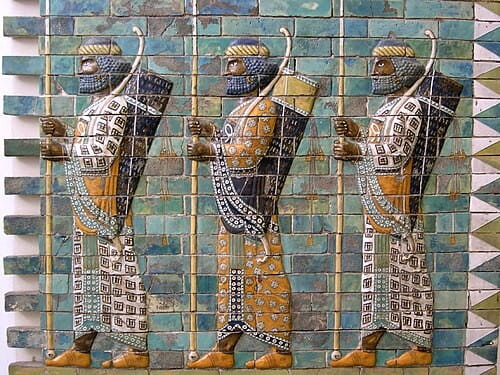
Moreover, Rubio’s claim regarding the exclusivity of concepts like “courage” and “honor” to Greco-Western civilization stems from a fundamental ignorance or conscious distortion of the long-standing intellectual and epic traditions of the East, particularly Iran—a land that, centuries before the codification of many Western texts, had formulated the ethics of chivalry and sacrifice for the homeland at the highest human level. The supreme manifestation of these virtues lies in Ferdowsi’s Shahnameh, where “honor” is intertwined with justice, keeping one’s word, and dignity, and “courage” is defined not as blind aggression, but as standing firm to the last breath to guard the nation and human dignity: “Let us all together give up our lives, rather than surrender our land to the foe.” Fundamentally, it was these sublime human concepts manifested in the Shahnameh that kept Iranians resistant and steadfast against the unequal and unjust war imposed by the US, providing them with the spirit of bravery.
Furthermore, contrary to Rubio’s biased claims interpreting martyrdom as a “death cult” or a desire for destruction, martyrdom in the Islamic intellectual framework and philosophy is not a glorification of death or a negation of life, but the pinnacle of safeguarding honor and the reality of human existence. The martyr is never enamored with non-existence, suicide, or blind violence—such as terrorist and suicide operations—but is an individual who holds life, dignity, and collective freedom so sacred that, in the face of aggression and tyranny, they prefer “the conscious and courageous choice of facing death on the battlefield of defense” over living in humiliation. In this intellectual framework, death is not the ultimate goal, but the price a superior human pays to stop corruption, defend the foundation of society, and preserve transcendent human values; thus, martyrdom is the manifestation of a “cult of life, honor, and conscious resistance.”
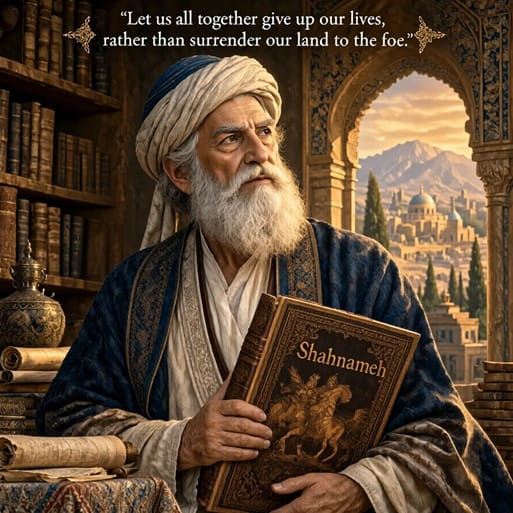
It seems that by delivering such a speech, Rubio intends to strip the irrational, illegal, and unpopular US war against Iran of its aggressive and expansionist nature and, by transforming it into a “civilizational battle,” manufacture an ideological pretext based on antiquarianism to justify it. By using terms like “Persian invaders,” he tries to reverse the roles of aggressor and the aggressed, portraying the US (on behalf of the West) as being under attack by Iran, thereby sending a message to Europeans that they must stand with the US in attacking Iran and support this aggression. As such, it seems that—as Vali Nasr, a former advisor to Obama, has said—the era of “Islamophobia” is being replaced by “Iranophobia.”
- https://www.state.gov/releases/office-of-the-spokesman/2026/10/secretary-of-state-marco-rubio-remarks
- Herodotus, The Histories, with an English translation by A. D. Godley, Cambridge: Harvard University Press, 1920, Book VII, 8b; Accessible online at: Perseus Digital Library.
- The British Museum, The Cyrus Cylinder (Collection Online: Object W_1880-0617-1941), Translation by Irving Finkel, Curator of Cuneiform Collections. Accessible online at: org.
- https://x.com/vali_nasr/status/2108533166814450114