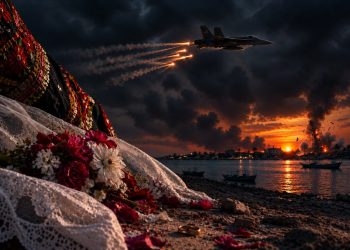
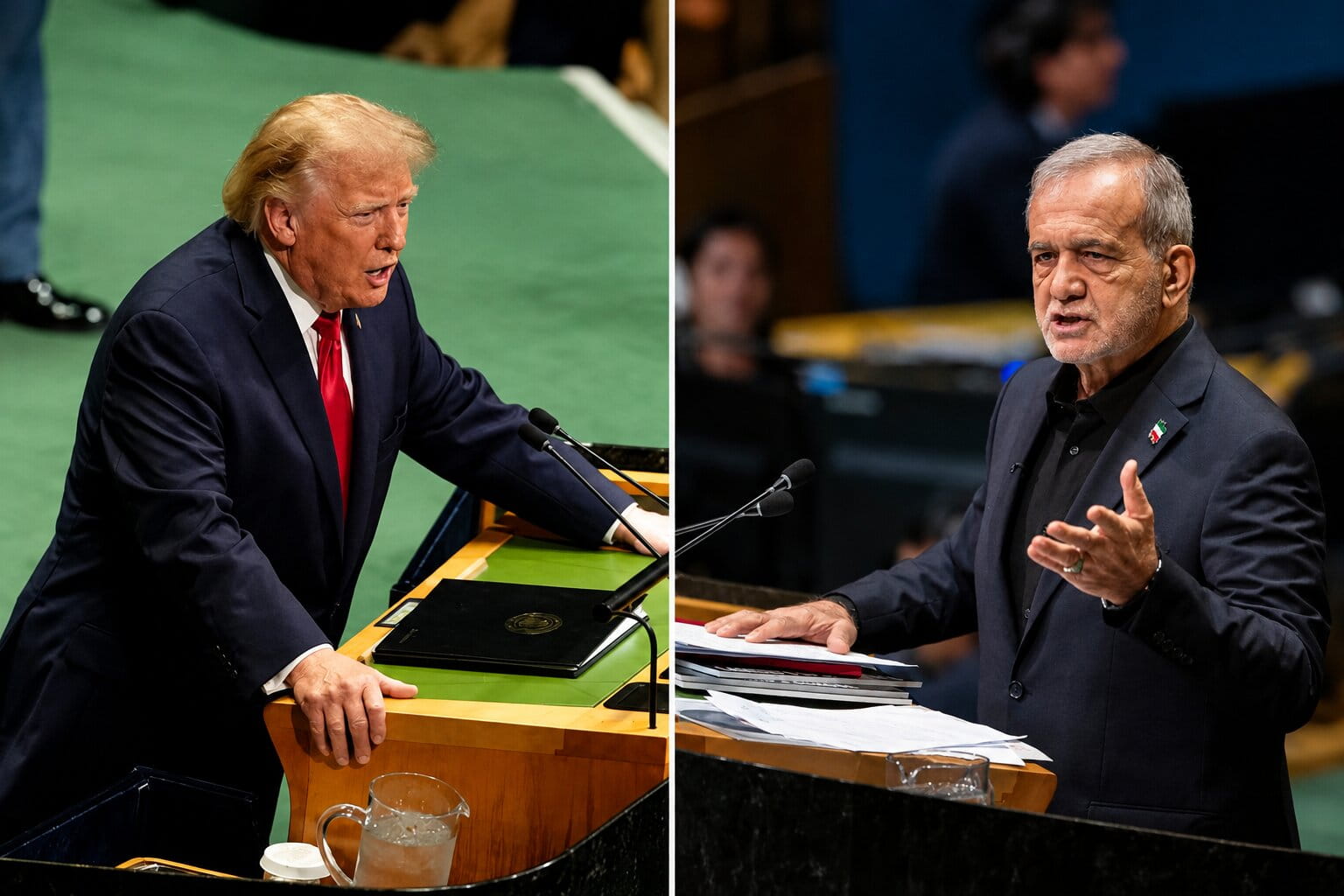
In September 2026, the eighty-first annual session of the United Nations General Assembly was convened pursuant to Article 20 of the United Nations Charter. It is no secret to anyone that the maintenance of international peace and security, the promotion of friendly relations among nations, and mutual cooperation toward the resolution of international problems were the objectives underlying the establishment of this 81-year-old organization. These objectives, following the immense devastation of the Second World War, were earnestly pursued by states and required setting out on a path that would safeguard the world from war and unrest. Both during the Cold War and after the collapse of the Eastern Bloc, war, unrest, and humanitarian crises continued unabated in various parts of the world. In recent years, the effectiveness of the United Nations has likewise come under criticism from many quarters. Yet we now witness that the very organization meant to be a forum for dialogue and the peaceful resolution of disputes has itself become a stage for threat and intimidation.
Donald Trump, President of the United States, in his address to the United Nations General Assembly, notwithstanding his claim to seek peace, resorted to threatening language and employed insulting characterizations against the Iranian nation, accusing Iran of being a source of instability (1) — This notwithstanding that, under his administration, the United States has attacked Iran and several other countries and has likewise committed war crimes — crimes such as the attack on the Minab school, which has shaken public opinion and the world’s media. The United Nations Charter, among its principles, obliges all Members to settle their international disputes by peaceful means in such a manner that international peace, security, and justice are not endangered; The Charter has declared unlawful not only the use of force, but also the threat thereof (2). The United Nations General Assembly has been a fundamental organ in the elaboration of the foundational rules and principles of international law; instruments such as the Convention on the Prevention and Punishment of the Crime of Genocide, the International Covenant on Civil and Political Rights, the International Covenant on Economic, Social and Cultural Rights, the Convention against Torture, and the Rome Statute of the International Criminal Court were either directly adopted by the General Assembly or were instruments in whose drafting the Assembly played an influential role. In light of this background, statements such as “annihilating Iran” stand in complete contradiction to the very foundations of international law, and in effect disregard the right to life of human groups, the right of nations to self-determination, and human dignity and worth.
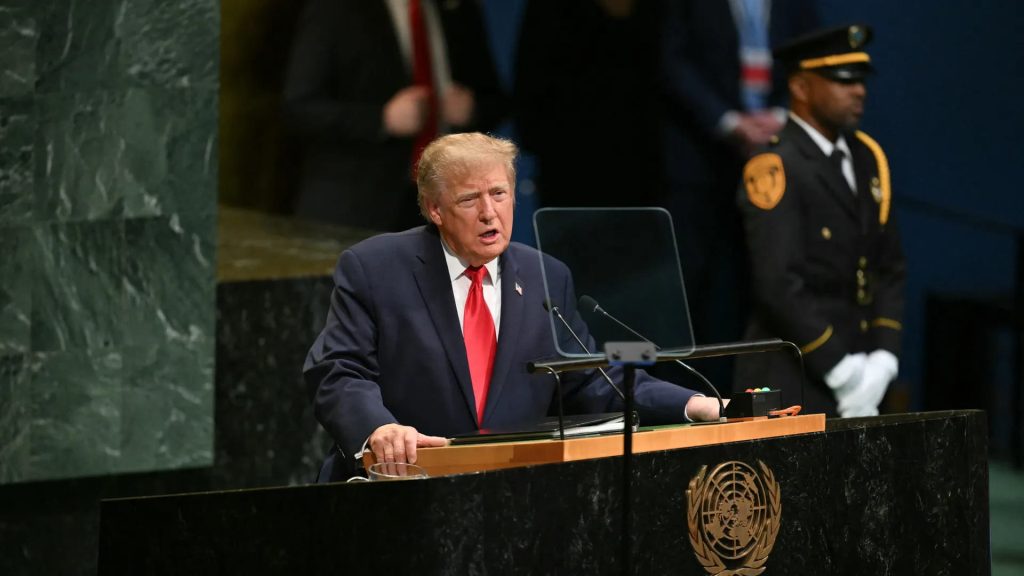
Trump accuses Iran of supporting terrorism, while U.S. and Israeli military attacks in recent wars have directly targeted civilians and instilled widespread terror among ordinary people. The instilling of terror among the civilian population is one of the recognized elements in the definition of terrorist acts, and therefore, accusations leveled by those who have themselves fueled such consequences reveal a manifest contradiction. Furthermore, Trump presides over a country that is not only a permanent member of the Security Council, but also the host of the main headquarters of the United Nations. A country that, more than any other member, ought to bear responsibility for safeguarding the international legal order—notwithstanding that it hosts the symbolic podium of that very order on its own soil—now issues threats and seeks to justify its unlawful acts from that same podium.
A few hours after Trump, Masoud Pezeshkian, President of Iran, delivers an address to the United Nations General Assembly (3). A comparison of his rhetoric with that of Trump reveals meaningful differences to the world’s public opinion. Pezeshkian speaks of an attempt on the life of Iran’s leadership—an act that violates the principle of non-intervention and the political independence of states. He refers to events that constituted clear instances of grave breaches of the four Geneva Conventions, amounting to war crimes and crimes against humanity: the direct attack on the Minab school, which resulted in the deaths of more than 150 students; and the large-scale attack on the city of Lamerd using cluster munitions, which made it impossible to observe the principle of distinction. In addition, the President of Iran also refers to attacks on several schools, hospitals, a university center, energy infrastructure, and a bridge.
He speaks of violations of international law by the United States and Israel. He speaks of acts that, under international criminal law, constitute international crimes — acts that threaten global peace and security. Pezeshkian once again revisits the assassination of Iranian scientists: civilians who were targeted during the twelve-day and forty-day wars, and whose assassination violated not only the right to life and the principle of distinction under international humanitarian law, but also the right to enjoy the benefits of scientific progress and its applications.
Pezeshkian states in his address: “If international law is enforced only when it suits the interests of the powerful, more countries will conclude that they must rely solely on their own strength to secure their security, and this will mark the beginning of a more dangerous world for all of us.” These words echo the very warning that many politicians and scholars have offered regarding the future of international law—a warning against practices that could render the international system akin to the eras of the devastating First and Second World Wars and the age of colonialism. With the difference that, in the present age, barbarity and bullying seek to reproduce themselves in the guise of positive law. The President of Iran refers to a historical fact: that “Iran has not attacked any country for approximately 200 years.” This fact must be considered alongside the point that, throughout this period, Iran has repeatedly been attacked by various countries, including Tsarist Russia, the former Soviet Union, Britain, the United States, Iraq, and Israel, and that its people have likewise fallen victim to various terrorist organizations, such as the Mojahedin-e Khalq Organization, Komala, ISIS, and separatist militant groups. This historical fact illustrates why Iran’s efforts to enhance its military capability are significant. No rule of international law prohibits states from possessing conventional weapons; indeed, the possession of such weapons is a prerequisite for exercising the right of self-defense under Article 51 of the United Nations Charter.
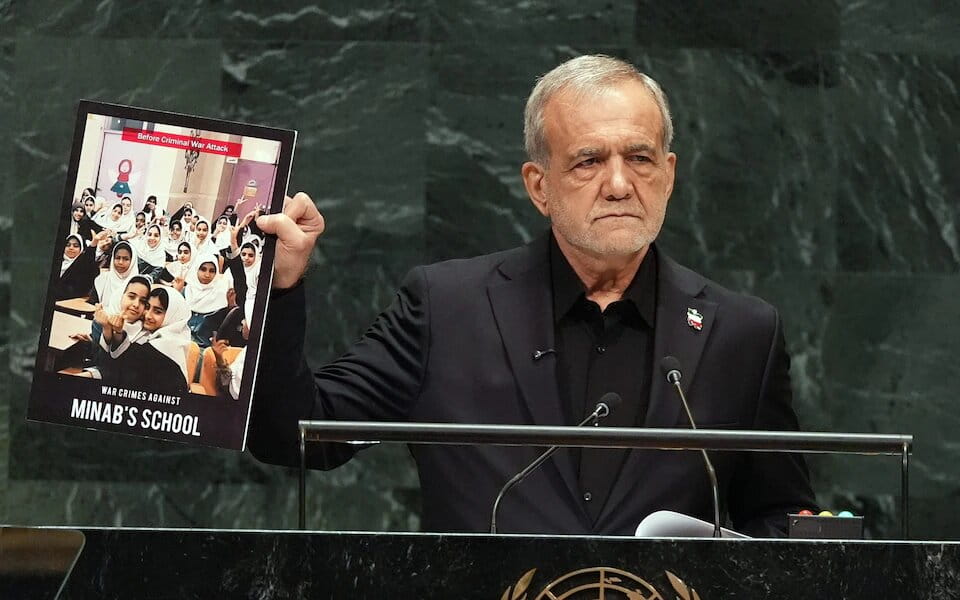
Pezeshkian makes a noteworthy remark: “The atomic bomb is in Israel, but the inspectors are in Iran. Israel kills, yet Iran is sanctioned. This is a tragedy that makes whoever you tell it to laugh. It kills, and we are sanctioned — and then the sanctions, in reality, target the poor, the sick, and innocent people.” Iran has repeatedly shown itself willing to negotiate over its nuclear program and, through agreements such as the JCPOA, has accepted voluntary restrictions and extensive monitoring of its nuclear industry by the International Atomic Energy Agency. Yet Iran is accused of breaching the peace, while Israel, which is not a party to the Treaty on the Non-Proliferation of nuclear weapons, enjoys complete impunity. This is a form of double standard that calls into question fairness and justice within the international arena (4).
The President of Iran, in his address, uttered a sentence that resonated widely around the world: “Either we will build security together, or we will endure insecurity together.” Has Pezeshkian issued an unlawful threat, or has he merely pointed to an unavoidable reality? The recent wars of aggression waged by the United States and Israel against Iran demonstrated that the initiation of a hostile act can set off a chain of dominoes. Israel, in order to carry out its attacks, violated the airspace of several countries, and the United States likewise made use of bases located on the territory of Iran’s neighboring States. Iran, for its part, cannot forgo its right of defense against the relentless attacks of the aggressors. It is here, given the geography of the region, that insecurity becomes widespread—an insecurity that stems not from Iran’s response, but from the conduct of the aggressors. The closure of the Strait of Hormuz is likewise a consequence of the creation of such insecurity.
In conclusion, it should be noted that Pezeshkian, notwithstanding that Iran has, throughout recent wars, been the target of flagrant violations of the rules of international law, once again spoke of cooperation with the world, of negotiation in defense of Iran’s interests, and of giving priority to dialogue and peaceful means. At the same time, he emphasized that the Iranian nation would not submit to pressure and bullying, yet he held diplomacy to take precedence over the language of force. These statements reveal the difference between two approaches: one that regards threats as a tool of bargaining, and another that, even in the position of victim, keeps the path of dialogue open. The one who gives priority to dialogue knows full well how painful the devastation and harm of war are, and how essential it is to preserve the order of international law.