


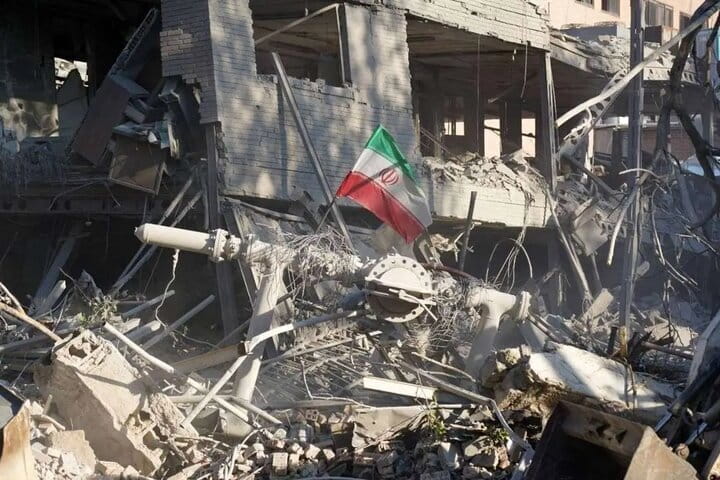
Attack on Academic and Higher Education Centers: Sharif University of Technology
Sharif University of Technology has been the study place of a large number of top Iranian elites since the 1960s. This university has repeatedly ranked at the top of Iranian universities in international rankings and was ranked 375th in the world in the QS ranking in 2026 (1). Sharif University is nicknamed the MIT of Iran due to its very important position in the field of applied sciences and technology. It is a name that is more than just a higher education institution; one that has played a remarkably prominent role in advancing Iran’s achievements in fields such as satellites, power and water infrastructure equipment, physics, plasma, astronomy, robotics, mathematics, nanotechnology, mechanical engineering projects, telecommunications, computer science, civil engineering structures, aerospace engineering, and artificial intelligence.
In line with the achievements brought about by Sharif University, its faculties and several affiliated research centers have played a key role. One of these centers was the university’s Information and Communication Technology Center (Computing Center). On April 6, 2026, a joint US-Israeli airstrike completely destroyed this site during the forty-day war. Initial estimates place the damage from this attack at 10 trillion tomans (Iranian tomans). The Department of Philosophy of Science and the Transportation Research Institute, which were adjacent to this center, also sustained extensive damage. Furthermore, the university mosque, which was also located near the impact site, suffered damage.
The Information and Communication Technology Center was significant because it housed the university’s artificial intelligence infrastructure and high-performance computing center. Most importantly, it also served as host for Iran’s national artificial intelligence infrastructure. The center also had a historical background, having been active since the 1960s as the Computing Center. It is said that this center was responsible for correcting the answer sheets for Iran’s first nationwide university entrance exam (2). Many companies—even some banks and institutions—used this center’s infrastructure to store their data (3).
The project to launch the country’s national artificial intelligence infrastructure began in 2024. This endeavor involved the collaboration of numerous Iranian elites and professors, along with the participation of several scientific institutions and knowledge enterprises. The Information Technology Center of Sharif University played a fundamental role in this initiative. The initial version of the national artificial intelligence platform was unveiled in 2025, providing the center’s services to various institutions and organizations. It was projected that the platform’s launch would lead to the emergence of 1,000 to 2,000 new businesses and generate a market worth 40 trillion tomans or more (4). This data center served approximately 1,500 companies, and nearly 760 knowledge-based companies operating in the vicinity of the university had deployed their servers and data infrastructure at this center.
According to the president of Sharif University of Technology, the institution had been training artificial intelligence models in Persian for two years and providing services to hundreds of companies. He believes the attack on these centers and the destruction of their infrastructure stems from the enemy’s desire to prevent Iran from achieving AI technology; According to him, due to U.S. sanctions and competitive advantages, no country was willing to provide Iran with the necessary knowledge and skills for working on artificial intelligence technology, and all related research was carried out domestically (5).
Beyond the fact that scientific and academic institutions, as civilian centers, are under the general protection of international humanitarian law, they also enjoy specific protection, including under Article 27 of the Fourth Hague Convention (6). Rule 38 of Customary International Humanitarian Law recognizes the prohibition against attacking scientific and educational institutions (7). Only military necessity or the military use of these facilities can exempt them from international protection and authorize them to be targeted. However, in the case of Sharif University of Technology, there was no evidence of the presence of forces or equipment within the university or any military activity inside the Information Technology Center.
The attack on Sharif University of Technology exemplifies the U.S. and Israeli policy of destroying Iran’s non-military infrastructure. Such attacks clearly demonstrate that the aggressors’ claims of countering threats to regional peace and security are merely a pretext for targeted attacks aimed at hindering Iran’s progress and development.
References
- https://www.topuniversities.com/universities/sharif-university-technology
- https://en.isna.ir/news/1405031105928/Sharif-University-Exemplifies-Resilience-Academic-Journey-Continues
- https://farsnews.ir/Leila_ghorbani/1778408965413062489/%D8%AD%D9%85%D9%84%D9%87-%D8%A8%D8%A7%D9%85%D8%AF%D8%A7%D8%AF%DB%8C-%D8%A8%D9%87-%D9%82%D9%84%D8%A8-%D9%81%D9%86%D8%A7%D9%88%D8%B1%DB%8C-%D8%B4%D8%B1%DB%8C%D9%81-%D8%AE%D8%B3%D8%A7%D8%B1%D8%AA-%DB%B1%DB%B0-%D9%87%D9%85%D8%AA%DB%8C-%D8%A8%D9%87-%D8%AF%DB%8C%D8%AA%D8%A7%D8%B3%D9%86%D8%AA%D8%B1-%D8%AF%D8%A7%D9%86%D8%B4%DA%AF%D8%A7%D9%87
- https://farsnews.ir/Razieh_Belali/1776579253624079772/%D8%AC%D8%B2%D8%A6%DB%8C%D8%A7%D8%AA-%D9%BE%D8%B1%D9%88%DA%98%D9%87-%D9%85%D9%84%DB%8C-%D9%87%D9%88%D8%B4-%D9%85%D8%B5%D9%86%D9%88%D8%B9%DB%8C-%DA%A9%D9%87-%D9%87%D8%AF%D9%81-%D8%AD%D9%85%D9%84%D9%87-%D8%AF%D8%B4%D9%85%D9%86-%D9%82%D8%B1%D8%A7%D8%B1-%DA%AF%D8%B1%D9%81%D8%AA
- https://www.aljazeera.com/news/2026/4/7/top-university-says-us-israel-attack-targeted-irans-progress-ai-learning
- https://ihl-databases.icrc.org/en/ihl-treaties/hague-conv-iv-1907/regulations-art-27?activeTab=default
- https://ihl-databases.icrc.org/en/customary-ihl/v1/rule38