


Following the collapse of the Islamabad Memorandum of Understanding, the U.S. government announced a broad campaign aimed at the complete economic isolation of Iran. In line with this, the U.S. Department of the Treasury imposed a new wave of sanctions against the country. For several decades, U.S. sanctions have placed immense pressure on ordinary Iranians, negatively affecting the supply of essential goods (e.g., medicines, healthcare supplies), necessary equipment (e.g., in the aviation, energy, and medical industries), and access to certain services. Sanctions have had a wide-ranging impact, and the fields of knowledge and education have not been immune. The new U.S. sanctions have now further intensified these restrictions for Iranians.
On 24 August 2026, the Office of Foreign Assets Control (OFAC), an agency operating under the purview of the U.S. Department of the Treasury, promulgated the suspension of General License G. OFAC general licenses operate to exempt specified activities from the ambit of prohibitions levied against Iran, thereby authorizing U.S. persons to engage in the activities enumerated within such licenses absent the requirement of obtaining a specific license. General License G authorized certain academic exchanges and educational services with Iran, including student exchanges, scholarships, admissions, registration, tuition processing, online educational courses offered by U.S. universities, professional certification examinations, and university entrance examinations for individuals residing in Iran (1). The suspension of this general license is expected to create numerous obstacles and challenges for Iranians in education and higher education. This action broadens the scope of sanctions in science and education. It is also important to note that even when sanctions do not explicitly prohibit an activity, private actors and governments often resort to over-compliance, citing caution and de-risking, to avoid the risk of punishment by the United States for sanctions violations. On the other hand, diverse criteria have been established in the enforcement of proscriptions, such that in all instances, domicile within Iran—and in certain instances, both domicile and the possession of Iranian instruments of identity or other identity markers—activates the proscription.
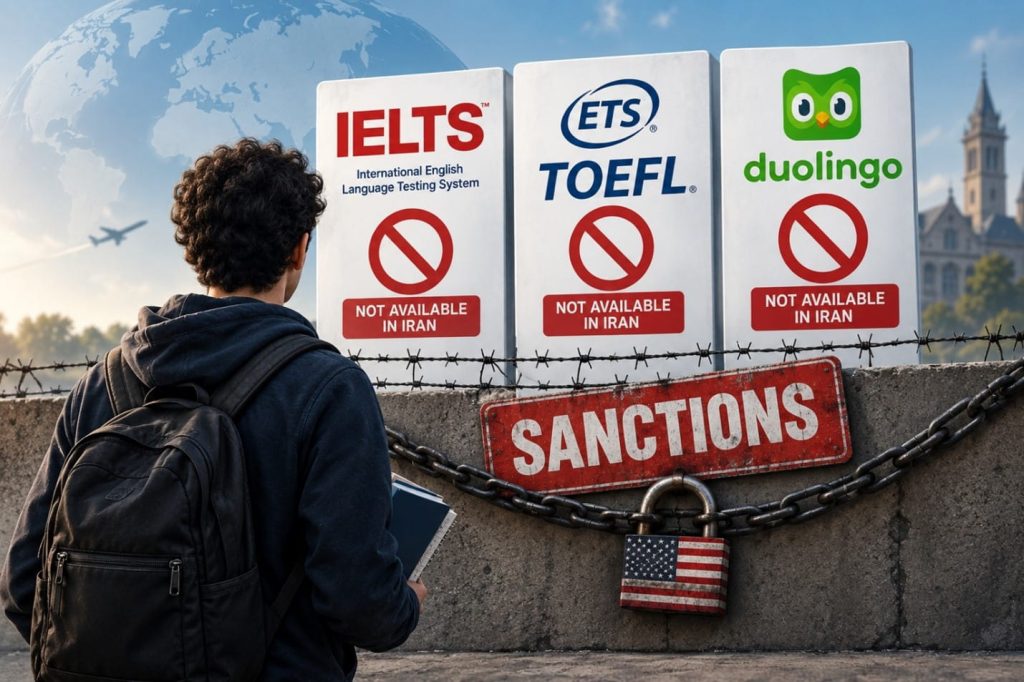
In recent days, the first repercussions of this measure have become apparent with regard to language examinations. Duolingo announced that, due to action by the U.S. Department of the Treasury, it is suspending the administration of the English language test to individuals who take the test in Iran or use identity documents issued by Iran. This restriction also extends to Iranians outside their country who use Iranian identity documents. Duolingo implemented its decision as of 1 September 2026 (2).
The Educational Testing Service (ETS), which administers numerous international standardized tests, also announced the suspension of TOEFL and GRE tests in Iran, following the decision of the U.S. Department of the Treasury (3). One of ETS’s spokespersons said in an emailed statement to Al Jazeera: “This step reflects our full compliance with U.S. sanctions law.”(4). Taking standardized English language tests is one of the requirements for admission to foreign universities, and this indefinite suspension blocks the pathways on which thousands of Iranian students inside the country have relied to access universities abroad (5).
Concurrent with restrictions on standardized English language tests, U.S. universities are also imposing restrictions on Iranians, claiming compliance with sanctions. For example, in its 11 September 2026 guideline, Ohio State University announced that providing online courses, distance education, or fee-based education, advising or mentoring at the graduate level, and employment and salary payments to individuals residing in Iran is prohibited without a specific federal license. Accordingly, the university cannot engage in targeted recruitment in Iran. Furthermore, the evaluation of applications, the review of transcripts, and the processing of application fees or tuition from individuals residing in Iran are prohibited and must cease immediately (6). The University of Pennsylvania and Indiana University have also imposed restrictions on individuals residing in Iran similar to those of Ohio State University. They have further stipulated that facilitating, funding, or supporting the participation of Iranian residents in conferences or similar events in the United States or other countries is prohibited without a specific license (7)(8).
The Law School Admission Council (LSAC), a non-profit entity comprised of over 200 member law schools situated in the United States, Canada, and Australia, and which is charged with the administration of the Law School Admission Test, the oversight of the admissions process, the provision of academic credential evaluation services, and the dissemination of pertinent information to prospective applicants to its member institutes, has issued that, in compliance with United States sanctions, the LSAC is henceforth unable to render any services to individuals who possess citizenship or residency in Iran (9).
The effects of the suspension of General Licence G have also become apparent with regard to the acceptance of articles. For example, Dr. Shahin Akhondzadeh, Deputy Minister for Research and Technology at Iran’s Ministry of Health, announced in a post on the social media platform X:
This is no longer a matter of scientific sanctions; it is scientific warfare. I prepared a paper for submission to the journal Neuropsychobiology. However, as soon as I began the submission process, I encountered a screen indicating that due to sanctions Iranians are barred from even submitting manuscripts to the journal via this dashboard. So much for America’s “free scientific world” and the separation of science from politics (10).
The aforementioned restrictions shall be evaluated in accordance with the corpus of human rights norms and international standards. The adverse impacts of unilateral coercive measures on the realization of human rights have been a recurring subject of scrutiny by the special rapporteurs of the UN Human Rights Council and other international experts. These restrictions impinge upon the enjoyment of substantial human rights, particularly the right to education, as articulated in Article 13 of the International Covenant on Economic, Social and Cultural Rights, and the right to participate in cultural life, to enjoy the benefits of scientific progress, and to freedom of scientific research (Article 15 of the said Covenant) are the most fundamental rights that are overshadowed by scientific sanctions. The foregoing rights are also recognized, respectively, in Articles 26 and 27 of the Universal Declaration of Human Rights. Beyond human rights norms, international standards, including UNESCO standards, also address various dimensions of the right to education and access to educational facilities. These include the 2021 UNESCO Recommendation on Open Science, which emphasizes equality of opportunity in access to, participation in, and benefit from science, regardless of factors such as geographical location and nationality.
It should be noted that in cases where the mere possession of Iranian nationality results in the denial of access to educational and scientific opportunities, the violation of the human rights principles of equality and non-discrimination on the basis of nationality is also established.
It is not an exaggeration to argue that the extension of sanctions to the sphere of the right to education and scientific activities may constitute a violation of international law. Such sanctions are imposed with the aim of harming the Iranian people and serve to escalate tensions beyond the existing political and security disputes. Such hostile policies warrant unequivocal condemnation by the international community.
References
- OFAC, Iran Sanctions: General licenses, https://ofac.treasury.gov/sanctions-programs-and-country-information/iran-sanctions, Last Seen 21 September 2026.
- Duolingo English Test, https://testcenter.zendesk.com/hc/en-us/articles/48404390966925-Is-The-Duolingo-English-Test-available-in-Iran, Last Seen 21 September 2026.
- ETS, Update on Testing in Iran, https://www.ets.org/iran-testing-update.html, Last Seen 21 September 2026.
- Aljazeera, Duolingo D-Day: Iranians question latest US sanctions targeting education, (1 September 2026), https://www.aljazeera.com/news/2026/9/1/duolingo-d-day-iranians-question-latest-us-sanctions-targeting-education, Last Seen 21 September 2026.
- Newsweek, Trump Sanctions Leave Iranian Students Lost in the Middle, (17 September 2026), https://www.newsweek.com/trump-sanctions-leave-iranian-students-lost-in-the-middle-12454898, Last Seen 21 September 2026.
- OSU, Updated Guidance: Remote Education and Operations Involving Iran, (11 September 2026), https://research.osu.edu/updated-guidance-remote-education-and-operations-involving-iran, Last Seen 21 September 2026.
- UPenn, Suspension of Iran-related General Authorizations, (26 August 2026), https://researchservices.upenn.edu/2026/08/26/suspension-of-iran-related-general-authorizations/, Last Seen 21 September 2026.
- Indiana University, Regulatory Alert: Suspension of Iran-Related OFAC General Authorizations, (24 August 2026), https://rso.iu.edu/news/2026-08-28-rso.html, Last Seen 21 September 2026.
- Inside Higher Ed, Iranian Students Barred From LSAT, (14 September 2026), https://www.insidehighered.com/news/quick-takes/2026/09/14/iranian-students-barred-lsat, Last Seen 21 September 2026.
- Shahin Akhondza, X, https://x.com/ShahinAkhondza3/status/2098733018865135848, Last Seen 21 September 2026.