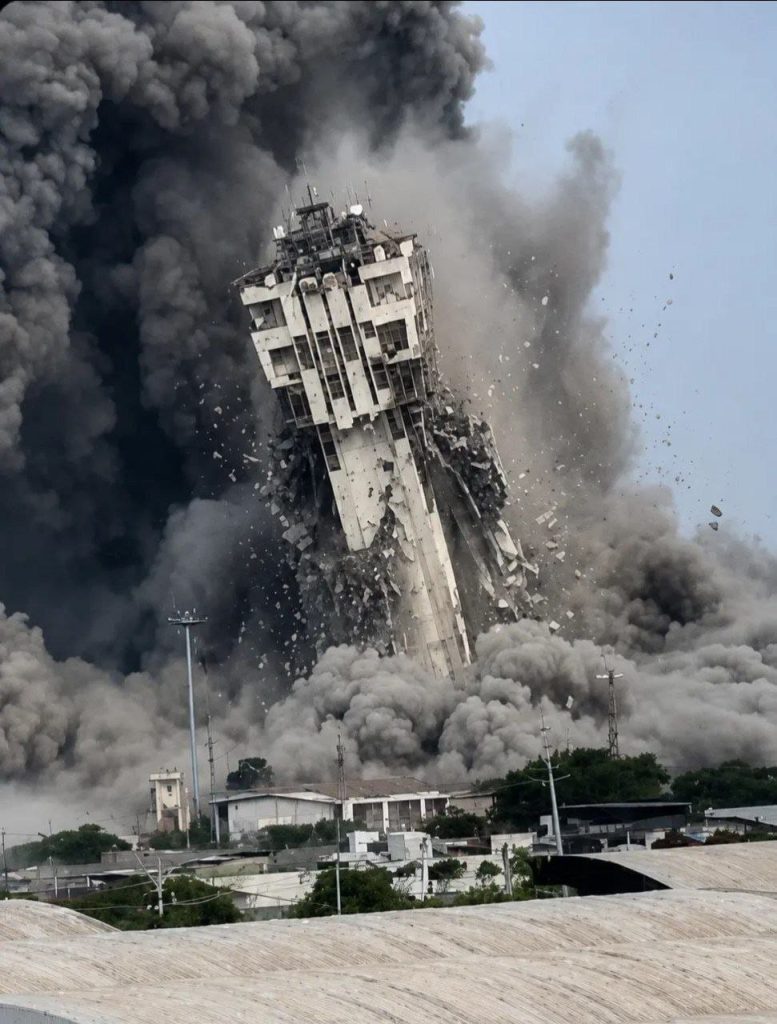
Some infrastructures are not merely functional; they also serve as symbols of a city’s development and beauty—symbols that take on a distinctive presence in visual advertising. The white maritime control tower was precisely such a symbol for the city of Chabahar. Chabahar is the most important port in southeastern Iran on the Makran coast and holds a strategic position, providing access to the Indian Ocean. The maritime control tower at Shahid Kalantari Port in Chabahar played a prominent role in maritime trade and the monitoring of shipping, while also serving as a symbol of pride for the city’s residents. The Chabahar Tower had enhanced the city’s visual identity as one of Iran’s most important centers of maritime trade. The U.S. military did not spare the tower during its airstrikes on Iranian territory, carrying out several attacks on the structure between July 8 and July 17, 2026, and ultimately destroying it.
Maritimes Control Towers are considered part of Vessel Traffic Services (VTS). The scope of these systems’ activities includes providing simple informational messages to ships (such as the positions of other vessels or weather warnings) and managing traffic within a port and waterway. Article 12 of Chapter V of the International Convention for the Safety of Life at Sea (SOLAS) provides that Contracting Governments may, at their discretion, construct VTSs where necessitated by the volume of traffic or the inherent degree of danger (1). In the same vein, Iranian specialists and engineers constructed the Chabahar maritime control tower, which was inaugurated in 2021–2022. The tower had full oversight of the port entrance and the ships’ access channel and was regarded as one of southeastern Iran’s most important maritime traffic control centers. Equipped with coastal radars, surveillance cameras, maritime communication systems, and navigational data, this VTS had become the command center for the port’s maritime transport and oversaw the movement of various commercial vessels (2).
The importance of VTSs places them in the category of critical infrastructure. Pursuant to the definitions provided, infrastructure includes equipment and facilities, the disruption of which would demonstrably impair public health, national security, civic welfare, and the economic development of a country. The interesting thing to note is that U.S. regulations also have a similar approach to the word infrastructure (3). The Chabahar maritime control tower was regarded as vital civilian infrastructure owing to its major role in maritime safety and the facilitation of commercial communications. According to the Iranian government spokesperson, the tower also played an important role in supporting relief forces (4).
Pursuant to the principle of distinction, the corpus of customary international humanitarian law (5), and Article 52 of Additional Protocol I to the four Geneva Conventions (6), the targeting of civilian objects is proscribed. Such acts, when committed under specified conditions, may constitute war crimes within the framework of international criminal justice.
American officials carry out aggressive actions against Iranian territory under the pretext of international peace and security. However, events such as the destruction of Iran’s infrastructure—including the Chabahar maritime control tower—reveal their true nature. These attacks demonstrate how the claim of defending global security can be twisted into an instrument for destroying vital civilian infrastructure. The destruction of the tower is not only a violation of international law but also, from a moral standpoint, reveals the actors’ disregard for the importance of such sites to economic and commercial development, the enhancement of maritime transport safety, and even the livelihoods of coastal residents.
https://naqshyad.com/en/project/chabahar-marine-control-tower-building/
- https://www.imo.org/en/ourwork/safety/pages/vesseltrafficservices.aspx
- https://donya-e-eqtesad.com/fa/tiny/news-4282934 (In Persian)
- E Beigzadeh, “Assaults on Critical Infrastructure and International Law,” Legal Research Quarterly, 28 4 (2025): 3-22, doi: 10.48308/jlr.2025.241688.2965.
- https://dolat.ir/detail/485468 (In Persian)
- https://ihl-databases.icrc.org/en/customary-ihl/v1/rule7
- https://ihl-databases.icrc.org/en/ihl-treaties/api-1977/article-52?activeTab=