


On the evening of September 1, 2026, the armed forces of the United States targeted areas in southern Iran in their attacks. US military officials, in their first official statements, claimed that these attacks were carried out against military installations of the Islamic Republic of Iran—claims that have consistently been accompanied by falsification intended either to erase civilian victims from memory or to justify their deaths through seemingly plausible fallacies. It is worth noting that these regions had previously been subjected to similar attacks. One such region was Sirik County in Hormozgan Province, which, according to the most recent official census in 2016, has a population of over 45,723. This county lies in close proximity to Minab County, where the US military carried out the bloody Shajareh Tayyebeh school catastrophe. In the course of the attack on Sirik on the 10th of Shahrivar, an event unfolded that, in the public mind, recalled the Minab catastrophe and the brutal attack on Lamerd County.


That night, in the town of Kuhestak, part of Sirik County, a traditional wedding ceremony was underway in one of the residential homes, attended by a large gathering that included women and children. The holding of this celebration amid war and military threats was itself a message affirming the continuity of life. As the first reports of the American attacks were transmitted, news of the strike on this wedding ceremony was also released. This attack wounded approximately 60 people and killed five, including one child.
What one expects of a wedding celebration are moments in which families come together so that joyful, memorable scenes may unfold — moments that, in the future, are preserved for revisiting a cherished past. Yet suddenly, the occurrence of a bitter event leaves behind a memory that no one wishes to recall. Now, if this bitter event is a direct military strike and the bombing of the ceremony itself, its psychological effects will never leave those who were present. These psychological effects will be far heavier still for the families of the victims. Hence, even once the wounded are treated and the bodies of the victims are laid to rest, this wound will nonetheless remain.
The US military never makes a distinction between military and civilian targets in its attacks. Despite public awareness of this reality, American officials either continue to make false claims about respecting civilian immunity in war or simultaneously claim that they are investigating the scale of attacks that have harmed civilians (1). However, just as America evades accountability for the attack on Minab school and Lamerd city, it will do so this time as well.
The principle of distinguishing between military and civilian objectives is one of the fundamental principles of international humanitarian law (2), and is similarly emphasized in the U.S. Department of Defense Law of War Manual (3); As the satellite image below shows, a telecommunications tower exists at a distance of more than one hundred meters from the house where the wedding ceremony was being held. The satellite image below has been cited by media outlets, press, and news agencies around the world, such as The New York Times and Reuters. The New York Times calculated the distance between these two locations as 137 meters; other news sources also had relatively similar estimates of this distance (4). Given the distance between locations, harm to civilians cannot be considered collateral damage to be justified by military necessity. On the other hand, information from eyewitnesses of the attack and evidence that has been obtained show that the wedding venue was independently targeted as a direct target of the attack.
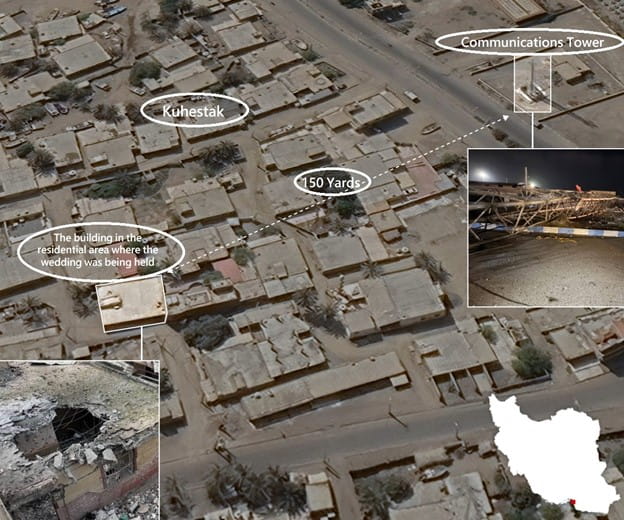

A Satellite Image of The Distance from The Wedding Venue to The Telecommunications Tower
According to eyewitness accounts, the impact site was in a section designated for women, which is why the majority of the wounded were women and children. According to one of the neighbors of the attacked house, whose account was also covered by ABC News, most of the wounded in this attack were children, and distressing scenes were observable (5). Noteworthy is a sentence posted by one of the wedding guests a few hours after the attack, which was also referenced by The New York Times: “They weren’t enriching uranium at the wedding, nor was the wedding close to a military area” (6).
Among the most important evidence available are weapons traces discovered at the impact site. According to the statement of the Chief Justice of Hormozgan Province, an identification code with the number 962214 was inscribed on the bomb’s body, which according to the U.S. defense supply chain database exclusively belongs to Raytheon weapons company (7). These findings align with analyses by international experts. According to a weapons expert and The New York Times’ visual analysis, the remaining weapon parts are components of an American bomb. According to him, the rear wing and bomb shell match a guided weapon system called the “AGM-154 Joint Standoff Weapon (JSOW)”; this remaining piece is also comparable to samples found in Yemen and Venezuela (8).
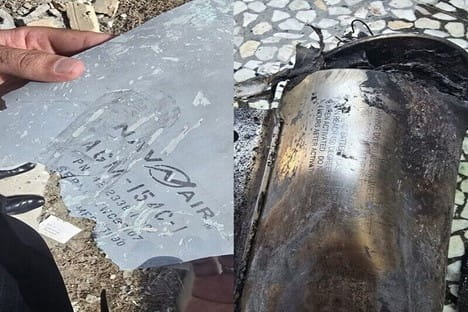

Image Of the Bomb Used in The Attack on The Kuhestak Wedding Ceremony / Photo Source: IRNA
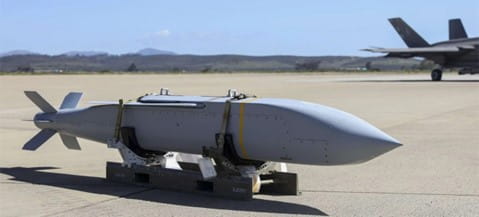

This is a Harpoon air-launched cruise missile, a long-range guided anti-ship missile manufactured by Raytheon for the US Navy and Air Force, which gives aircraft the ability to attack targets outside the range of enemy air defense. However, with the use of this missile, the wedding venue is directly targeted for attack.
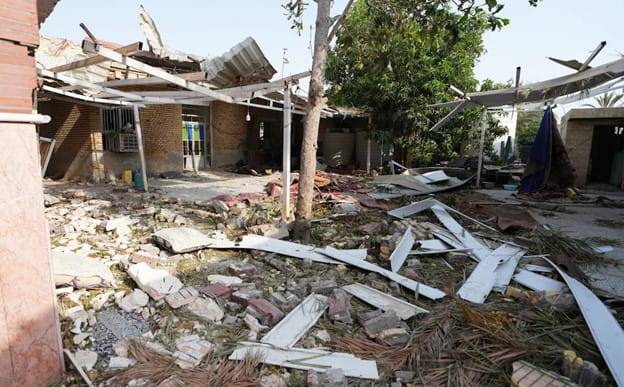
Ruins resulting from the American attack on a wedding ceremony in Kuhestak / Image source: ISNA News Agency

In conclusion, it should be noted that the US Army also has a history of targeting wedding ceremonies in its past wars in Iraq and Afghanistan. Among them are the attack on a wedding ceremony in Karok village, Uruzgan Province, Afghanistan with over 100 killed (July 1, 2002), the bombing of a wedding in Bakr al-Dhayb village, Anbar Province, Iraq (May 19, 2004), the bombing of a wedding in Fallujah, Iraq with 13 martyrs including the groom (October 8, 2004), the bombing of a wedding in Deh Bala, Nangarhar, Afghanistan with 47 martyrs (June 6, 2008), and the bombing of a wedding in Waj Baghtoo, Kandahar, Afghanistan with 23 child martyrs (November 2008) (9).
America’s impunity and lack of accountability show that Iran will not be the last victim, just as Afghanistan and Iraq were not the last victims.
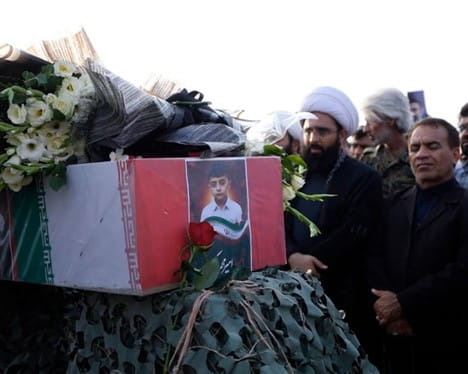

Funeral Procession for The Victims of The Attack on The Kuhestak Wedding Ceremony / Image Source: Getty Images
References
- Aljazeera, ‘Things happen’: How Vance’s comment on Iran wedding strike fits US pattern, https://www.aljazeera.com/news/2026/9/4/things-happen-how-vances-comment-on-iran-wedding-strike-fits-us-pattern, accessed 13 September 2026.
- ICRC, The Principle of Distinction between Civilians and Combatants, https://ihl-databases.icrc.org/en/customary-ihl/v1/rule1.
- S. Department of War, Department of Defense Law of War Manual, https://media.defense.gov/2023/Jul/31/2003271432/-1/-1/0/dod-law-of-war-manual-june-2015-updated-july%202023.pdf, accessed 13 September 2026.
- Nukta, Deadly strike on Iranian wedding was likely a direct hit by a US munition, analysis shows, https://nukta.com/strike-on-iranian-wedding-direct-hit-us, accessed 13 September 2026.
- ABC News, Women gathered in a small Iranian town for a wedding. Then deadly strikes hit, https://abcnews.com/International/wireStory/women-gathered-small-iranian-town-wedding-deadly-strikes-136207573, accessed 13 September 2026.
- Ny Times, In Small Iranian Town, a U.S. Attack Turns a Wedding Into a Tragedy, https://www.nytimes.com/2026/09/02/video/iran-us-attack-wedding.html?eafs_enabled=false, accessed 13 September 2026.
- IRNA, the precise specifications of the bomb used in the American attack on the Kohstak wedding were announced, https://irna.ir/xjY9H9, accessed 13 September 2026. (In Persian)
- Ny Times, Op.Cit.
- IRNA, Need to pivot a wedding to a wake? Outsource to the US: Iran’s London Embassy, https://en.irna.ir/news/86254317/, accessed 13 September 2026.