


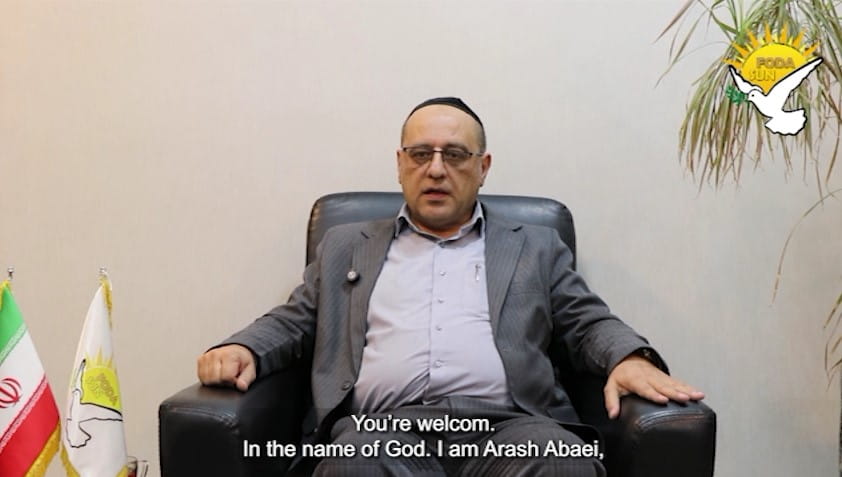
The Foundation of Dialogue and Solidarity of United Nations (FODASUN), on the one hand, with a view to promoting a culture of peaceful coexistence, strengthening mutual understanding among adherents of different religions, and honoring the cultural and religious diversity of Iranian society, and on the other hand, with regard to the consequences of the war waged by the United States and Israel against Iran in 2026, held a conversation with Mr. Arash Abaei, an engineer, a prominent member of Iran’s Jewish community, and a researcher of Jewish culture and religious practice. In this conversation, the historical background of the Jews in Iran and the beliefs of the Jewish religion regarding the tradition of peaceful coexistence among peoples were examined, and the place and characteristics of synagogues in Jewish culture were also explained for the audience.
Mr. Abaei also served as one of the prayer leaders at Rafi’-Nia Synagogue, which was located in central Tehran and was completely destroyed during the 2026 war against Iran. In this conversation, he discussed the historical and religious background of Rafi’-Nia Synagogue and its significance within Iran’s Jewish community. He also addressed the consequences of the 2026 war for Iranian society, particularly for the country’s Jewish community. Furthermore, he shared his views on the importance of distinguishing between Judaism as a religion and religious identity, and Zionism as a political movement. He emphasized the need to avoid attributing political positions and actions to the followers of an entire religion.
Iranian Jews possess a rich historical heritage. According to Encyclopædia Iranica, Jewish communities have resided on the Iranian plateau since approximately 721 BCE. This renowned source states that the Assyrians, during the reign of Sargon II (721–705 BCE), after conquering the northern kingdom of Israel, settled a large Jewish population in the land of the Medes (the western and northern regions of Iran). Following Cyrus, the Great’s conquest of Babylon in 539 BCE, all Jewish slaves were freed, and many migrated to Iran. A significant number also attained important positions during the Achaemenid period [1]. Iran is home to tombs attributed to Jewish prophets, including the Prophet Daniel in Susa [2] and the Prophet Habakkuk in Tuyserkan [3]. Additionally, a famous mausoleum in Hamadan is attributed to Esther and Mordecai, holding an important place in the collective memory of the Jewish people. According to available statistics, approximately ten thousand Jews reside in Iran. Under Article 13 of Iran’s Constitution, Jews are recognized as a religious minority and are free, within the limits of the law, to perform their religious rites and ceremonies. Furthermore, in matters of personal status and religious education, the principles of their faith are observed. Jews in Iran have numerous synagogues, dedicated schools, halls and conference centers, a home for the elderly, cultural centers, and dedicated associations such as “the Tehran Jewish Committee.”
1. Houman Sarshar, “Judeo-Persian Communities I. Introduction”, Encyclopedia Iranica, 15 June 2009, Last Update at 23 April 2018, Vol. XV, Fasc. 1, pp. 89-90, https://www.iranicaonline.org/articles/judeo-persian-communities-of-iran-i-introduction. Accessed 8 November 2026.
2. Amnon Netzer, Nicholas Sims-Williams & Parviz Varjavand, “Dānīāl-E Nabī”, Encyclopedia Iranica, 15 December 1993, Last Update at 20 November 2013, Vol. VI, Fasc. 6, pp. 657-660, https://www.iranicaonline.org/articles/danial-e-nabi, Accessed 8 November 2026.
3. Sorour Soroudi, “Ḥabaquq, Tomb Of”, Encyclopedia Iranica, 15 December 2002, Last Update at 6 July 2015, Vol. XI, Fasc. 4, p. 425, https://www.iranicaonline.org/articles/habaquq-tomb-of, Accessed 8 November 2026.